
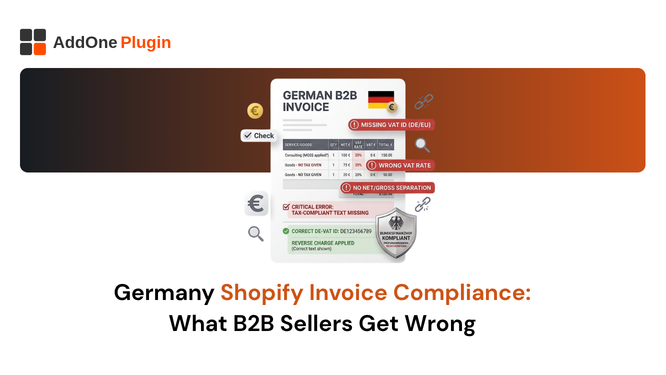
German B2B buyers have zero tolerance for non-compliant invoices. If a Steuernummer is missing, if the reverse charge language is wrong, or if there is a gap in your sequential invoice numbers, their accounting department will reject your document and delay your payment. Worse, their tax advisors may flag the transaction for audit, and you could find yourself liable for VAT you did not charge.
Germany has the most demanding invoice compliance rules in the EU, and most Shopify merchants selling into the German market are getting at least one of them wrong. This guide covers every common mistake, why it matters, and how to fix it permanently.
Why German Invoice Rules Are Stricter Than the Rest of the EU
Germany implements the EU VAT Directive at the strictest end of the permitted spectrum. The country’s domestic tax laws, particularly the German Turnover Tax Act (UStG), add requirements beyond the EU baseline. German tax authorities are known for detailed audits, and invoice compliance is one of their primary focus areas.
UStG §14 The Law Behind Every German Invoice
Section 14 of the German Umsatzsteuergesetz (UStG) defines the mandatory content of every tax invoice issued for a domestic B2B transaction. The requirements mirror the EU Directive but add specificity: the invoice must contain the Steuernummer or USt-IdNr of the seller, the full address of both parties, a detailed description of the service or goods, the unit price, the applicable tax rate, and both the net and gross amounts.
For intra-community supplies (cross-border B2B within the EU), UStG §14a adds additional requirements, including the mandatory inclusion of both parties’ USt-IdNr numbers and specific reverse charge language. German buyers will check for these fields before processing payment.
GoBD: The 10-Year Retention and Non-Alterability Rule
GoBD (Grundsatze zur ordnungsgemassen Fuhrung und Aufbewahrung von Buchern) is the German regulation governing the storage and integrity of business records. Under GoBD, all commercial invoices must be stored for ten years (recently amended to eight years from January 2025 under the Fourth Bureaucracy Relief Act), in their original format, without alteration.
The critical requirement for Shopify merchants: an invoice must be generated in a locked, immutable format. A Word document saved as PDF does not comply, because the source can be edited. Only invoices generated by a certified, audit-locked system satisfy GoBD. Most standard Shopify invoicing setups fail this requirement.
Why German B2B Buyers Reject Non-Compliant Invoices at Sight
German companies operate under strict internal compliance processes. Their tax advisors instruct them to reject any invoice that does not meet UStG §14 requirements, because accepting a non-compliant invoice and claiming input tax from it creates a tax risk for the buyer. You will receive a polite rejection and a request to reissue, at best. At worst, the buyer will cancel the order entirely.
The phrase Shopify merchants hear most often from German buyers: “We need a proper Rechnung, not a Bestellbestatigung.” An order confirmation is not an invoice in Germany, regardless of how you label it.
The Mandatory Fields Every German Invoice Must Include
A German VAT invoice must contain all of the following fields. Each is required under UStG §14, and a missing field invalidates the invoice for input tax purposes.
Seller and Buyer Legal Names, Addresses, and Tax IDs
The invoice must show the full legal name and complete address of both the seller and the buyer. A trading name is not sufficient if it differs from the registered legal name. The buyer’s full address must match their tax registration to enable input tax verification.
For domestic German sales, your Steuernummer is required. For cross-border intra-EU sales, your USt-IdNr (the EU VAT identification number starting with DE) is required. These are different numbers and serve different purposes. Using the wrong one for the wrong transaction type is a common mistake.
Steuernummer vs USt-IdNr: Which to Use and When
The Steuernummer is your domestic German tax number, assigned by your local Finanzamt. The USt-IdNr (Umsatzsteuer-Identifikationsnummer) is your EU VAT identification number, starting with DE followed by nine digits. For domestic sales within Germany, you may use either. For cross-border B2B sales to buyers in other EU countries, you must use the USt-IdNr, and you must also include the buyer’s USt-IdNr.
Always validate a buyer’s USt-IdNr through the VIES database before removing VAT from their invoice. If you apply zero-rating based on an invalid VAT number, you become liable for the VAT that should have been charged.
Sequential Invoice Numbers: Why Gaps Trigger Audits
German tax law requires that invoices be numbered in a continuous, unbroken sequence. A gap in the sequence, for example, jumping from invoice 2024-156 to 2024-158, is treated by tax authorities as evidence of hidden transactions. Even if the gap was caused by a cancelled order or a system error, it must be explained and documented.
This is a critical problem for Shopify merchants who cancel orders after invoice generation. If your invoicing system simply skips a number when an order is cancelled, you are creating audit risk. Your invoice app must handle cancellations by voiding the number and noting the cancellation, not by silently skipping it.
Line-Item VAT Breakdown at 19% Standard and 7% Reduced
Germany uses two main VAT rates: 19% standard and 7% reduced. The reduced rate applies to food, books, newspapers, cultural services, and certain other categories. Your invoice must show the tax rate and the tax amount separately for each applicable rate. If an order contains both 19% and 7% items, both subtotals must be itemised with their respective rates.
The German terms are Steuersatz (tax rate) and Steuerbetrag (tax amount). Including these in the correct German terminology on invoices sent to German buyers eliminates friction with their accounting teams.
What Happens When You Get Reverse Charge Wrong on a B2B Invoice?
The reverse charge mechanism is one of the most frequently mishandled areas of German B2B invoicing for cross-border Shopify merchants.
When the Reverse Charge Mechanism Applies (Intra-EU Cross-Border)
When you sell goods or services to a VAT-registered business in another EU country, you do not charge VAT. Instead, the buyer accounts for the VAT in their own country. This is the intra-community supply rule, and it applies regardless of the transaction value. You issue a zero-rated invoice with a mandatory reverse charge notation.
Importantly: if you sell from outside Germany to a German B2B buyer, the same principle applies. You do not charge German VAT. The German buyer accounts for it themselves under the Steuerschuldnerschaft des Leistungsempfangers rule.
The Exact Phrasing German Accounting Departments Expect
The legally recognised phrase for reverse charge invoices in Germany is: “Steuerschuldnerschaft des Leistungsempfangers.” This is the German-language statutory phrase required by UStG. While “Reverse Charge” in English is also legally permissible, using the German phrase eliminates any friction with buyer accounting teams.
InvoiceForge applies this language automatically when it detects a B2B order from a buyer with a verified EU VAT number. No manual template editing required.
Your Liability When the Buyer’s USt-IdNr Is Invalid
If you issue a zero-rated invoice to a buyer who provides an invalid or fraudulent USt-IdNr, you are liable for the VAT that should have been charged. This is an absolute liability in German tax law. The fact that the buyer gave you a bad number is not a defence, unless you can demonstrate that you validated it at the time of the transaction.
Always validate USt-IdNr numbers against the EU’s VIES system before applying zero-rating. An invoicing app that validates VAT numbers in real time and records the validation result protects you in the event of a dispute.
Three Invoice Mistakes Shopify Sellers Make in Germany
These three errors account for the majority of German invoice compliance problems reported by Shopify merchants.
Mistake 1: Using Shopify’s Order Confirmation as an Invoice
Shopify’s default order confirmation email is a receipt, not a Rechnung. It does not contain a Steuernummer or USt-IdNr, a sequential invoice number, a per-line VAT breakdown, or the buyer’s full legal details. German B2B buyers know this immediately, and they will tell you. Do not assume that renaming the email “Rechnung” or “Invoice” makes it compliant. The required fields must actually be present.
The fix is straightforward: install an invoicing app that generates a proper PDF Rechnung with all UStG §14 fields and delivers it automatically with every order.
Mistake 2: Missing or Incorrect VAT Breakdown on Mixed-Rate Orders
If you sell products subject to both 19% and 7% VAT in the same order, each rate must be shown separately with its own subtotal and tax amount. Many Shopify invoice templates show a single combined tax figure, which is incorrect for German compliance purposes. German accountants reconcile every line, and a combined figure fails that reconciliation.
The fix: ensure your invoice template is configured to group line items by VAT rate and show a subtotal for each rate with the corresponding tax amount.
Mistake 3: Editable PDFs That Fail GoBD Compliance
Saving an invoice as a PDF from a Word document or a spreadsheet does not produce a GoBD-compliant document. GoBD requires that the invoice be generated in a locked format by a certified system, such that it cannot be altered after generation. The source document (Word, Excel) can be edited, which means the PDF derived from it does not satisfy the non-alterability requirement.
The fix: use an invoicing app that generates PDFs directly from order data and locks them at the point of generation. InvoiceForge generates locked, immutable PDFs that satisfy GoBD requirements.
Does Shopify Generate GoBD-Compliant Invoices for Germany?
No. Shopify’s built-in VAT invoice feature is not GoBD-compliant and was not designed for the German market’s specific requirements.
What Shopify’s Native VAT Invoice Feature Actually Produces
Shopify Tax’s built-in VAT invoice for EU orders generates a basic PDF attached to the order status page. It includes the order details, your store name, and VAT calculations. For some simple B2C orders, this is adequate. For German B2B orders, it is not.
The Gaps: No GoBD Locking, No Steuernummer Field, No Auto-Delivery
Shopify’s native invoice does not support a configurable Steuernummer or USt-IdNr field independently. It does not lock invoices in a GoBD-compliant manner. It does not generate sequential invoice numbers distinct from Shopify’s order numbers. It does not detect reverse charge scenarios and apply Steuerschuldnerschaft language. And it does not email a PDF attachment automatically to the buyer.
Why German Merchants Need a Dedicated Shopify Invoice App
The combination of UStG §14 mandatory fields, GoBD retention rules, sequential numbering requirements, and reverse charge language creates a compliance stack that Shopify’s native features simply cannot address. A dedicated invoice app handles all of it automatically, and the setup time is measured in minutes, not weeks.
How InvoiceForge Handles German Invoice Compliance Automatically
InvoiceForge is configured to generate fully UStG §14-compliant invoices for German B2B orders from the moment it is installed.
All UStG §14 Mandatory Fields Pre-Configured
InvoiceForge’s German-market template includes dedicated fields for both the Steuernummer and the USt-IdNr, with logic to display the correct one based on whether the sale is domestic or cross-border. Buyer details, line-item VAT breakdowns by rate, and net/gross totals are all displayed in the format German accounting teams expect.
Install InvoiceForge free and start generating compliant Rechnungen from your first German order. No template coding required.
Locked Sequential Numbering With No Gaps on Cancellations
InvoiceForge’s sequential numbering system handles order cancellations correctly. When an order is cancelled after invoice generation, the system voids the invoice number and records the void, maintaining a continuous, auditable sequence. No gaps appear in your invoice register, and no manual adjustment is required.
Automatic Reverse Charge Detection for EU B2B Orders
When a buyer at checkout provides a valid EU VAT number, InvoiceForge validates it against the VIES database in real time. If the number is valid and the buyer is in a different EU country, InvoiceForge automatically applies zero-rating and adds the Steuerschuldnerschaft des Leistungsempfangers notation to the invoice. The validation result is stored with the invoice record for audit purposes.
Germany Invoice Compliance Checklist for Shopify B2B Sellers
Pre-Launch Setup Checklist
- German Steuernummer and USt-IdNr both entered in InvoiceForge settings
- Separate Steuernummer and USt-IdNr logic configured for domestic vs. cross-border orders
- Product VAT rates set correctly in Shopify (19% standard, 7% reduced)
- Mixed-rate invoice template configured to show separate subtotals by rate
- Sequential invoice number series initialised with a clear prefix (e.g., DE-2026-001)
- Reverse charge detection enabled for EU B2B buyers
- GoBD-compliant PDF generation and locking confirmed
- Retention settings configured for 8-year minimum storage
Per-Order Verification Checklist
- Confirm buyer’s USt-IdNr validated against VIES for cross-border B2B orders
- Verify reverse charge language appears on zero-rated B2B invoices
- Check that both net and gross amounts appear on the invoice
- Confirm invoice number is sequential with no gaps from previous invoice
- Verify the PDF is locked and cannot be edited after generation
German invoice compliance is not optional for merchants selling B2B into one of Europe’s largest markets. The consequences of non-compliance range from delayed payments to full tax audits, and neither is a situation worth risking for the sake of not setting up a proper invoicing app.
InvoiceForge handles every German compliance requirement automatically. Install free from the Shopify App Store and start generating GoBD-compliant Rechnungen from your next German order.