
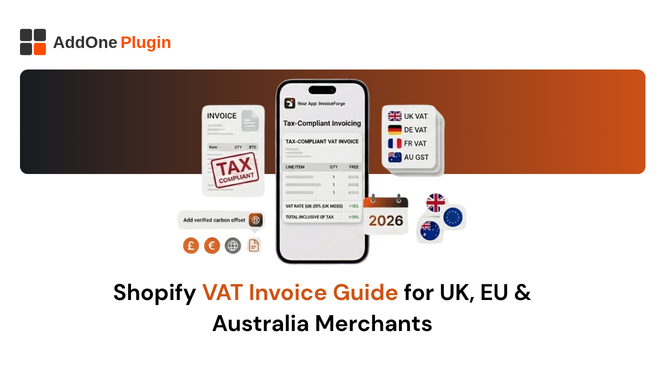
Your Shopify order confirmation email is not a tax invoice. For millions of merchants selling to businesses in the UK, EU, and Australia, that distinction is the difference between a clean audit and a compliance fine. Tax authorities in each of these regions have clear rules about what a valid invoice must contain, and the default Shopify receipt does not come close to meeting them.
This guide covers everything you need to know about Shopify VAT invoice requirements across three of the most important English-speaking markets: the United Kingdom, the European Union, and Australia. You will learn what each region demands, where Shopify falls short, and how to generate fully compliant invoices automatically for every order.
What Is a VAT Invoice and Why Does Shopify Require One?
A VAT invoice is a formal tax document that records a sale, identifies both parties, and shows exactly how much tax was charged. It is not the same as a receipt or an order confirmation. Understanding this distinction is the foundation of compliance.
VAT Invoices vs Standard Order Confirmations
A Shopify order confirmation email confirms that an order was placed. It lists the products, the total, and the shipping address. What it does not include is the seller’s VAT registration number, a sequential invoice number, a per-line tax breakdown, or the buyer’s business details. These are the fields tax authorities need to verify that VAT was correctly charged and remitted.
For B2C customers, an order confirmation is usually enough. For B2B customers, a proper tax invoice is a legal requirement. Without it, your buyer cannot reclaim input tax on their VAT return, which means they will keep asking you for a real invoice, or they will stop buying from you.
When a VAT Invoice Is Legally Required (B2B vs B2C)
In the UK and EU, you must issue a VAT invoice to any VAT-registered business customer. This is mandatory, not optional. The rule applies whether the transaction is domestic or cross-border. In Australia, you must issue a tax invoice to any customer purchasing over AUD $82.50 if you are GST-registered, regardless of whether they are a business.
For B2C retail sales, the requirements are lighter, but they still exist. A simplified invoice may be acceptable for low-value retail sales in the UK and EU. For Australia, a standard receipt that includes your ABN and the GST amount usually satisfies the requirement for retail purchases under the threshold.
The Cost of Getting It Wrong: Penalties by Region
Issuing non-compliant invoices exposes your business to penalties from multiple directions. HMRC can deny VAT input tax credits to your buyers, which damages your wholesale relationships. EU tax authorities can issue fines per non-compliant invoice. In Germany, an invoice gap in your sequential numbering can trigger a full tax audit. In Australia, the ATO can disallow GST credits claimed against invoices that do not include your ABN.
The practical business cost is just as significant. B2B buyers whose accounts payable teams reject your invoices simply delay payment, raise disputes, or move to a supplier who sends proper documentation.
UK VAT Invoice Requirements for Shopify Stores
The UK operates under HMRC’s VAT rules, which are governed by the VAT Act 1994 and HMRC Notice 700/21. Since Brexit, UK VAT rules apply independently of EU rules, and Shopify merchants selling to UK customers must comply with HMRC’s specific requirements.
Mandatory Fields on a UK VAT Invoice (HMRC Rules)
A full UK VAT invoice must include all of the following:
- A unique, sequential invoice number
- The date of issue
- The date of supply (the tax point), if different from the invoice date
- Your business name and address
- Your VAT registration number (format: GB followed by 9 digits)
- The buyer’s name and address
- A description of the goods or services supplied
- Quantity and unit price for each item
- The VAT rate applicable to each item
- The total amount excluding VAT
- The total VAT charged
If any of these eleven fields are missing, the invoice is non-compliant. Your buyer cannot use it to reclaim VAT.
Simplified vs Full VAT Invoices: Which to Use
HMRC allows a simplified invoice format for retail sales under £250. A simplified invoice does not need to show the buyer’s details or the net amount exclusive of VAT. It simply needs to show your name, address, VAT number, the supply date, a description of goods, and the VAT-inclusive price with the rate applied.
For all sales over £250, and for any B2B sale regardless of value, a full VAT invoice is required. Most Shopify B2B merchants default to full invoices for all orders, which is the safest approach.
Making Tax Digital (MTD) and Invoice Record-Keeping
MTD for VAT has been mandatory for all VAT-registered businesses since April 2022. This means you must keep digital records of all invoices and submit VAT returns through MTD-compatible software. Shopify holds transaction data but does not submit your VAT return for you. You need an accounting integration or an invoicing app that produces compliant digital records.
From April 2026, MTD for Income Tax also applies to sole traders with income above £50,000, extending the digital record-keeping requirement further. The UK government has also signalled a mandatory e-invoicing programme targeting 2029, which will require structured digital invoice formats. Starting compliant now protects you from future disruption.
EU VAT Invoice Requirements for Cross-Border Shopify Sales
EU VAT is governed by the VAT Directive (2006/112/EC), which sets minimum requirements that all EU member states must apply. In practice, individual countries add their own requirements on top, with Germany being the most demanding. If you sell to EU customers, you need to meet the Directive’s baseline and be aware of country-specific additions.
Standard EU Invoice Fields (Directive 2006/112/EC)
The EU VAT Directive requires invoices to include the sequential invoice number, the supply date, your VAT identification number (USt-IdNr for Germany, TVA for France, BTW for the Netherlands), the buyer’s VAT number for B2B transactions, a clear description of goods or services, the quantity, the net amount, the VAT rate applied, and the total VAT amount.
For cross-border B2B sales within the EU, you must also indicate the applicable VAT scheme. If you are using the One-Stop Shop (OSS) scheme, your invoice must show the VAT number under which you are registered and the rate applicable in the buyer’s country.
Reverse Charge Invoicing for B2B Cross-Border Orders
When you sell to a VAT-registered business in another EU country, you do not charge VAT. Instead, you issue a zero-rated invoice and include the phrase “Reverse charge: VAT to be accounted for by the customer.” This is not optional language. Tax authorities and buyer accounting teams look for this exact notation.
Shopify does not automatically add reverse charge language to invoices. If you are selling B2B cross-border in the EU, you need an invoicing app that detects when a buyer has provided a valid EU VAT number and applies reverse charge language automatically.
OSS, IOSS and How They Affect Your Invoice Format
The EU’s One-Stop Shop (OSS) scheme allows you to register for VAT in one EU country and account for VAT on all cross-border B2C sales through a single return. The Import One-Stop Shop (IOSS) applies to low-value imports under €150 from outside the EU.
Under OSS, your invoices must show the VAT rate of the buyer’s destination country, not your home country’s rate. Under IOSS, the VAT is declared at checkout and must be clearly shown on the shipping documentation. Both schemes affect how you structure your invoice, and both require accurate record-keeping that Shopify alone cannot provide.
Australia GST Invoice Requirements for Shopify Sellers
Australia’s Goods and Services Tax (GST) is administered by the Australian Taxation Office (ATO). At a flat rate of 10%, it applies to most goods and services sold in Australia. Unlike VAT, GST is not a multi-rate system, which makes calculation straightforward, but the invoice requirements still catch many Shopify merchants out.
ABN, 10% GST Rate, and Tax Invoice Thresholds
You must register for GST once your annual turnover to Australian customers exceeds AUD $75,000. Once registered, every sale must include 10% GST, and your invoices must display your Australian Business Number (ABN). For sales over AUD $82.50, you must issue a full tax invoice. For sales below this threshold, a simplified document is acceptable.
Your ABN is an 11-digit number issued by the ATO. Without it on your invoice, your buyer cannot claim the GST credit on their Business Activity Statement (BAS). This is a common problem for Shopify stores: the platform does not natively display your ABN on customer-facing documents.
GST-Free Exports When You Do Not Charge GST
If you ship goods internationally and the goods leave Australia within 60 days of invoice or payment, those sales are GST-free. You still need to record them in your accounts and report them on your BAS, but you do not include GST in the price. Your invoice should clearly state that the supply is GST-free.
If goods remain in Australia for longer than 60 days, GST applies even for international customers. This rule catches merchants who fulfil from Australian warehouses with slower shipping operations.
BAS Reporting and Why Your Invoice Format Matters
Every GST-registered business must submit a Business Activity Statement (BAS) to the ATO every quarter. Your BAS reports how much GST you collected from customers and how much you paid to suppliers. Accurate invoices are your primary record-keeping tool for BAS preparation.
An invoice app that automatically calculates and displays GST per line item, captures ABN numbers, and exports records in a format compatible with accounting software like Xero or MYOB makes BAS preparation significantly faster and reduces the risk of ATO errors.
Does Shopify Generate Compliant VAT and GST Invoices Natively?
This is the question every international Shopify merchant asks. The answer is: partly, for some regions, with significant gaps.
What Shopify’s Built-In VAT Invoice Feature Covers (EU and UK Only)
Shopify Tax includes a VAT invoice generator for EU and UK orders. When enabled, it attaches a PDF invoice to the order status page. This covers 26 EU countries and the UK. The invoices include your VAT number, the buyer’s address, and the VAT breakdown.
This is a useful starting point for straightforward B2C sales. However, it was not designed for complex B2B invoicing, wholesale operations, or the specific compliance requirements of individual countries like Germany’s GoBD rules.
Where Shopify Falls Short: Australia, Customisation, and B2B
Shopify’s native VAT invoice feature does not cover Australia at all. Australian GST invoices with ABN display are simply not available out of the box. Shopify’s community forums are filled with merchants discovering this problem after receiving requests from B2B buyers for proper tax invoices.
For B2B operations, native invoices also lack: sequential invoice numbers that survive order cancellations, buyer VAT number capture and validation, reverse charge language, credit note generation, PO number display, and automatic email delivery to buyers. These are the standard features that B2B customers expect.
Why Most Merchants Add a Dedicated Invoice App
A dedicated invoicing app picks up where Shopify leaves off. It connects directly to your Shopify orders, reads customer data and tax settings, generates a compliant PDF, and delivers it automatically. For merchants selling across regions, an invoicing app is not optional; it is the only practical way to maintain compliance at scale.
How InvoiceForge Automates VAT and GST Invoicing on Shopify
InvoiceForge is a Shopify invoicing app built specifically for merchants who need compliant tax documentation across the UK, EU, and Australia without manual effort.
Auto-Generated Invoices With Region-Specific Compliance Fields
InvoiceForge reads your store’s tax settings and customer data and automatically populates the correct compliance fields for each region. UK orders get all eleven HMRC-required fields. EU orders get VAT number validation and reverse charge language where applicable. Australian orders get your ABN displayed prominently with the 10% GST breakdown.
Every invoice is generated the moment an order is placed, with no manual trigger required.
Branded Templates With VAT Number, ABN and Reverse Charge Logic
Beyond compliance, InvoiceForge gives you fully branded invoice templates that include your logo, colours, and business identity. You do not need to choose between looking professional and being compliant. Both happen automatically from the same template.
Reverse charge detection is built in. When InvoiceForge identifies a B2B order from a buyer with a verified EU VAT number, it automatically applies zero-rate invoicing with the correct legal language. No manual intervention required.
One-Click Credit Notes, Proforma Invoices, and Delivery Notes
InvoiceForge handles the full document set that B2B buyers expect: invoices, credit notes for refunds, proforma invoices for orders requiring prepayment approval, and delivery notes for shipped goods. Each document is linked to the corresponding order and invoice, maintaining a complete audit trail.
Ready to stop patching Shopify’s invoice gaps with spreadsheets and manual PDFs? Install InvoiceForge free from the Shopify App Store and generate your first compliant VAT or GST invoice in under two minutes.
Step-by-Step Setting Up Compliant Invoices for Each Region
Setup varies slightly by region, but the process is fast regardless of where your customers are located.
UK Setup Checklist
Before generating UK VAT invoices:
- Register for VAT with HMRC and add your VAT number to Shopify under Settings > Taxes and duties
- Set up MTD-compatible accounting software (Xero, QuickBooks, or similar)
- Install InvoiceForge and configure your invoice template with your legal business name and address
- Enable auto-send for all UK orders
- Test with a draft order to confirm all 11 HMRC fields appear correctly
EU Setup Checklist
For EU VAT compliance:
- Register for OSS if your cross-border B2C sales exceed €10,000 annually
- Add your EU VAT number (USt-IdNr, TVA, etc.) to your Shopify and InvoiceForge settings
- Enable VAT number capture at checkout so B2B buyers can enter their registration number
- Configure reverse charge rules in InvoiceForge for verified B2B buyers
- Verify that Germany-specific fields (sequential numbering, GoBD locking) are active if you sell to German businesses
Australia Setup Checklist
For GST-compliant invoicing in Australia:
- Register for GST with the ATO once turnover exceeds AUD $75,000
- Add your ABN to your Shopify billing settings and your InvoiceForge template
- Set Australian tax rates to 10% in Shopify Settings > Taxes
- Configure GST-free product collections for exported goods
- Enable quarterly BAS export in your accounting integration
Frequently Asked Questions About Shopify VAT Invoices
Do I Need a VAT Number Before I Can Send Invoices on Shopify?
You need a VAT number to send legally valid VAT invoices. Without a registration number, your invoices cannot include VAT, and any document you send is technically a sales receipt. If you are below the registration threshold, you can still send professional invoices that show your business details without VAT; you simply note that VAT does not apply.
However, if your B2B buyers are VAT-registered, they will expect a proper VAT invoice. Voluntary VAT registration before hitting the threshold may be worth considering if B2B sales are significant for your store.
Can I Send One Invoice Format to All Regions?
No. Each region has different mandatory fields, different tax rates, and different document requirements. A UK VAT invoice showing only HMRC-required fields may not satisfy German GoBD requirements or Australian ATO requirements. The most effective approach is to use an invoice app that applies the correct template based on the delivery address of each order, generating region-appropriate documentation automatically.
VAT and GST compliance is not the most exciting part of running a Shopify store. But it is one of the most consequential. Non-compliant invoices cost you B2B relationships, invite audits, and create tax liability that eventually has to be settled. Getting your invoice setup right from the start means one less operational problem to solve as you grow.
InvoiceForge handles UK, EU, and Australian invoicing automatically from a single Shopify integration. Install free from the Shopify App Store and generate your first compliant invoice in minutes.