
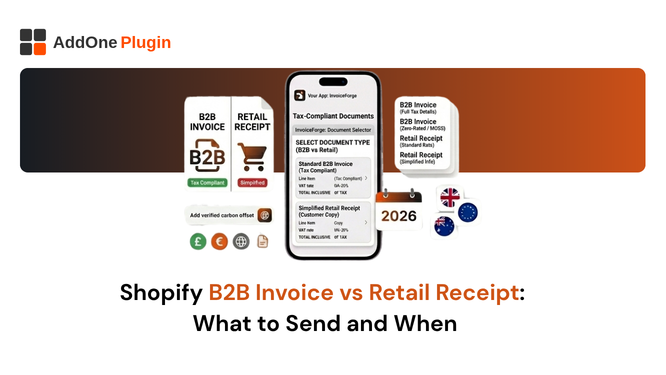
You just processed your largest wholesale order to date. Shopify sends its standard order confirmation. Your buyer emails back within the hour: “Can you send us a proper invoice? We need it for accounts payable.” Sound familiar? This situation plays out every day for Shopify merchants who have not distinguished between what to send B2B customers versus what to send retail buyers.
The difference between a tax invoice and a receipt is not just semantic. It is a legal distinction that affects your buyer’s ability to reclaim VAT or GST, your audit compliance, and your professional standing with wholesale accounts. This guide covers exactly what each document is, when you must send one versus the other, and how to automate the right document to the right customer automatically.
What Is the Difference Between an Invoice and a Receipt on Shopify?
These two documents serve fundamentally different purposes, created at different points in the transaction, for different audiences.
Invoice A Formal Request for Payment With Tax Details
An invoice is a formal commercial document issued by the seller to the buyer, requesting payment for goods or services. It contains a unique invoice number, both parties’ legal details and tax registration numbers, a line-by-line description of the goods, the applicable tax rate on each line, and the total amount due. In a B2B context, the invoice is often the document that initiates payment, particularly under deferred payment terms like Net 30 or Net 60.
For tax purposes, an invoice is the primary document that allows a VAT or GST-registered buyer to recover the input tax they paid. Without a compliant invoice, they cannot make that claim on their return.
Receipt: A Proof of Payment After Checkout
A receipt is a document confirming that payment has been received. It acknowledges the transaction after it is complete. A receipt does not need to contain all the tax-compliance fields that an invoice does. For a retail B2C customer who paid by credit card at checkout, a receipt is all they typically need.
Shopify’s order confirmation email functions as a receipt in most jurisdictions. It confirms what was ordered, what was paid, and how the customer was charged. For standard retail transactions, this is sufficient. For B2B, it is not.
Order Confirmation Email: Why It Is Neither
Shopify’s order confirmation sits in an awkward middle ground. It is labelled as an order confirmation, not an invoice or a receipt. It does not meet the legal definition of a tax invoice in any major jurisdiction, because it lacks mandatory fields like a sequential invoice number, the seller’s VAT registration number, and a per-line tax breakdown. But it is also not a formal receipt, since it is sent before fulfilment in many cases.
The practical problem: many Shopify merchants assume that because Shopify sends “something” automatically, they do not need to do anything else. For B2B customers, that assumption costs them payment delays, buyer friction, and compliance exposure.
When Must You Send a Tax Invoice Instead of a Receipt?
The rules vary by region, but the threshold for when an invoice is required follows a consistent pattern.
B2B Orders Your Buyer Needs It to Reclaim VAT or GST
Any VAT-registered business in the UK or EU, or any GST-registered business in Australia, needs a compliant tax invoice to recover the tax they paid on your goods. This is the core driver of B2B invoice requirements. The buyer’s tax authority will not accept a claim for input tax credit without a valid invoice from the supplier.
In the UK, you are legally required to issue a VAT invoice within 30 days of supply when requested by a VAT-registered business customer. In the EU, similar obligations apply under the VAT Directive. In Australia, the threshold is any taxable sale over AUD $82.50 to a GST-registered business.
Cross-Border Sales Regional Laws That Mandate Invoices
Cross-border B2B sales within the EU require invoices with reverse charge language and both parties’ VAT numbers. Sales from the UK to EU businesses require specific export documentation. Sales to businesses in Germany, France, and Italy often come with buyer-specific invoice format requirements beyond the EU baseline.
For merchants selling internationally, the safest approach is to issue compliant invoices for all B2B orders regardless of destination, using an app that applies the correct regional formatting automatically based on the shipping address.
Wholesale and Draft Orders With Net Payment Terms
Wholesale orders placed through Shopify’s draft order system often have deferred payment terms attached. In these cases, the invoice is the instrument that triggers the payment obligation, not just a record of a completed transaction. Your invoice must show the due date, the payment terms (Net 30, Net 60, etc.), and the total amount outstanding. The buyer’s accounts payable team uses this document to schedule payment. Without it, nothing happens.
When Is a Simple Receipt Enough?
Not every order requires a full tax invoice. Understanding where a receipt is sufficient saves you from over-engineering your document workflow for customers who do not need or want formal invoices.
Standard B2C Retail Checkout (Card Payment at Point of Sale)
A consumer buying a product from your Shopify store with a credit card, paying immediately at checkout, does not need a tax invoice. They need a receipt: confirmation that their payment was accepted, what they bought, and what they paid. Shopify’s order confirmation email satisfies this requirement in most countries.
The exception: if the B2C customer is in a country with specific consumer invoice requirements, such as some EU member states where retailers must provide tax receipts for all sales above a threshold, a more detailed document may be required. For most markets, the order confirmation is sufficient for B2C.
Low-Value Orders Below Regional Invoice Thresholds
The UK, EU, and Australia all have thresholds below which simplified or no invoices are required. In the UK, simplified invoices cover sales under £250. In Australia, sales under AUD $82.50 can use a simplified receipt format. For these small transactions, particularly in a B2C context, a receipt is legally adequate.
Practically speaking, if you are selling branded merchandise or consumer goods at retail prices, the majority of your orders will involve customers who simply want confirmation their order went through. Save the full invoice workflow for B2B customers who specifically need it.
Digital Product Sales to Non-Business Customers
Digital product sales, particularly software, ebooks, or downloadable assets, have their own tax treatment. In most markets, digital products sold to consumers are subject to VAT or GST at the consumer’s location. However, the documentation requirement for the consumer is still a receipt, not a full tax invoice, unless the consumer is a VAT-registered business.
For digital product merchants, the key trigger is whether the buyer has provided a VAT or GST registration number. If they have, they are acting as a business, and a full invoice applies.
What Goes Wrong When You Send the Wrong Document
Sending the wrong document to the wrong customer has real consequences, both financial and relational.
Buyers Cannot Reclaim Input Tax Without a Proper Invoice
This is the most direct consequence. A B2B buyer who receives an order confirmation instead of a tax invoice cannot claim back the VAT or GST they paid. That money sits with the tax authority instead of returning to their business. Most professional buyers know this, and they will chase you for a corrected invoice. The less forgiving ones will simply charge it to the cost of doing business with you and find a more organised supplier next time.
Audit Exposure: Missing Sequential Numbers and Tax Breakdowns
If your invoicing relies on order confirmation emails that are not sequentially numbered, not locked against editing, and not formatted with the mandatory tax fields, you have a compliance problem that only becomes visible during an audit. Tax authorities look for continuous invoice sequences and correct tax breakdowns. Documents that fail these tests create a liability.
The sequential numbering issue is particularly acute for merchants who cancel orders. Shopify’s order numbers do not form a continuous sequence when orders are cancelled. A proper invoicing system maintains its own sequential series independently of Shopify’s order numbering.
Lost Wholesale Accounts From Unprofessional Documentation
Wholesale buyers evaluate suppliers on reliability and professionalism. A supplier who consistently sends order confirmations instead of invoices, who sends invoices missing mandatory fields, or who cannot generate a credit note when a return is processed is a supplier who creates administrative work for the buyer’s team. Large wholesale accounts have enough complexity in their supply chains without adding an unreliable documentation partner.
First impressions matter in B2B. If your first invoice to a new wholesale customer is non-compliant, you are signalling that your operations are not ready for professional B2B trade.
How to Automate Document Routing by Customer Type on Shopify
The right solution is not to manually decide which document to send for each order. It is to set up automation that routes the correct document to the correct customer without any manual intervention.
Tagging Customers as B2B or Retail in Shopify
Shopify customer tags are the foundation of document routing automation. By tagging wholesale accounts with a “B2B” or “Wholesale” tag, and leaving retail customers untagged (or tagged as “Retail”), you create the segmentation that your invoicing app can act on. Setting up customer tags is straightforward in Shopify’s customer management panel, and it can be automated using Shopify Flow for customers who self-register on a wholesale portal.
Using InvoiceForge to Auto-Send Invoices to B2B and Receipts to B2C
InvoiceForge reads your customer tags and applies conditional logic: B2B-tagged customers receive a full, compliant tax invoice PDF by email automatically. Non-tagged retail customers can receive a simpler branded receipt, or rely on Shopify’s standard order confirmation. The routing is fully automated once configured.
You can also configure separate invoice templates for different customer segments: one template for domestic UK B2B, one for EU B2B with reverse charge, one for Australian wholesale with ABN display. InvoiceForge selects the right template based on the customer’s tag and shipping address. Install InvoiceForge free from the Shopify App Store and configure your routing rules in minutes.
Draft Order Invoices With Payment Terms for Wholesale
For wholesale orders processed through Shopify’s draft order system, InvoiceForge generates an invoice when the draft order is created, before payment is collected. This invoice includes the agreed payment terms, the due date, and payment instructions. The buyer receives the invoice immediately, their accounts payable team processes it, and payment arrives by the due date. The entire flow is documented and auditable from the moment the order is placed.
B2B Invoice vs Retail Receipt Quick Reference Comparison
Side-by-Side Field Comparison Table
Here is what distinguishes a full B2B tax invoice from a retail receipt:
- Sequential invoice number Required on invoice, not on receipt
- Seller VAT/GST number Required on invoice, not on receipt
- Buyer name and address Required on invoice, optional on receipt
- Buyer VAT/GST number Required on B2B invoice for cross-border, not on receipt
- Line-item tax breakdown Required on invoice, summary only on receipt
- Reverse charge language Required on cross-border B2B invoice, never on receipt
- Payment terms and due date Required on deferred-payment invoice, not applicable to receipt
- Net amount and gross amount Required on invoice, gross only on receipt
Decision Flowchart: Which Document to Send
Use this logic to determine the correct document for each order:
- Is the customer VAT or GST registered? Yes: send a full tax invoice. No: go to step 2.
- Is the order value above the regional simplified invoice threshold? Yes: send a full tax invoice. No: go to step 3.
- Has the customer requested a tax invoice? Yes: send a full tax invoice. No: go to step 4.
- Is the customer in a jurisdiction with mandatory invoicing regardless of registration? Yes: send a full tax invoice. No: a receipt or order confirmation is sufficient.
Getting the right document to the right customer is a process problem, not a knowledge problem. Once you understand the rules, the challenge is implementation at scale. Manual document selection does not work past a handful of orders per day.
InvoiceForge automates the entire process: the right document, formatted correctly for each region, delivered to the right customer, every time. Install free from the Shopify App Store and set up your routing rules in under ten minutes.