
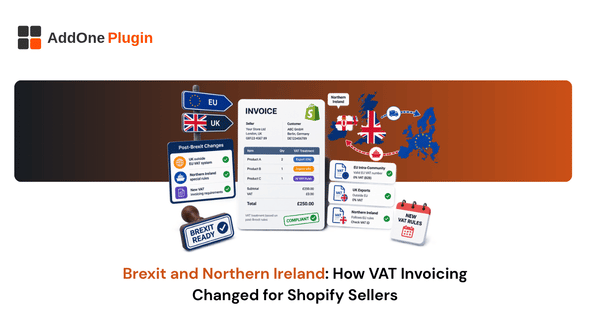
Great Britain and Northern Ireland look like one country on a shipping label, but for VAT purposes since Brexit, they run on two different rulebooks at once, and a Shopify store that treats them identically on invoices is going to get the VAT number wrong sooner or later. Northern Ireland’s dual position, following EU VAT rules for goods and UK VAT rules for services, is genuinely one of the more confusing corners of post-Brexit compliance, and it’s easy to see why: nothing about the physical geography or the shipping process makes the distinction visible until the invoice itself gets it wrong. This guide covers how the Windsor Framework’s dual regime actually works and what it means for the invoices your Shopify store issues to customers on either side of the Irish Sea.
Why Northern Ireland Has a Different VAT Position at All
Understanding the dual regime starts with understanding the political problem it was designed to solve.
The Problem the Windsor Framework Was Built to Avoid
When the UK left the EU, a hard customs and regulatory border between Northern Ireland and the Republic of Ireland was considered politically unacceptable, given the history of the region. The solution, first under the Northern Ireland Protocol and later refined under the Windsor Framework, was to keep Northern Ireland aligned with EU rules for goods specifically, while treating it as fully part of the UK for services and most domestic purposes. The Windsor Framework, agreed in 2023, eased some of the original Protocol’s stricter customs checks while keeping this fundamental goods-versus-services split in place.
Goods Follow EU Rules, Services Follow UK Rules
This split is the single most important thing to understand about Northern Ireland VAT: it is not one dual system, it is two separate systems applied depending on what’s actually being sold. Goods moving between Northern Ireland and the EU follow EU VAT treatment, while services supplied from or to Northern Ireland generally follow standard UK VAT rules, the same as a transaction anywhere else in Great Britain. A single business selling both a physical product and an installation or support service to the same EU customer could genuinely need to apply two different VAT treatments within one overall transaction.
The XI VAT Number: What It Is and When You Need It
The most visible sign of this dual system on an actual invoice is a VAT number prefix most sellers had never seen before 2021.
GB Prefix for Services, XI Prefix for EU Goods Trade
A Northern Ireland business can hold two VAT identifiers simultaneously: their existing GB-prefixed number for services and UK-domestic trade, and an XI-prefixed number specifically for goods transactions with the EU. The XI number is an add-on to an existing GB VAT registration rather than a separate registration in its own right, and it’s the version that’s recognized on the EU’s VIES validation system, since GB numbers are no longer visible there at all. A business with a Belfast or wider Northern Ireland postcode is often issued an XI number automatically once HMRC identifies them as trading under the Windsor Framework, without needing to apply for a brand new registration from scratch.
When Your Invoice Needs to Show XI Instead of GB
If you’re a Northern Ireland business selling goods to a VAT-registered customer in the EU, your invoice needs to show your XI-prefixed number rather than your GB one, since that’s the number your EU customer’s own VAT validation and reclaim process will be checking against. The same business selling a service to that same EU customer, or selling goods domestically within the UK, continues using the GB-prefixed number as normal. Getting this wrong isn’t just a cosmetic error: an EU customer trying to validate a GB number against VIES for a goods transaction will find nothing, since GB numbers were removed from that system entirely after Brexit, which can stall their own VAT reclaim or reverse charge treatment on the purchase until the correct number is provided.
What Changed for Great Britain Sellers Shipping to Northern Ireland
If your business is based in Great Britain rather than Northern Ireland, the changes are smaller but still worth understanding.
GB to NI Is Treated as a Domestic UK Movement
Goods moving from Great Britain into Northern Ireland are generally treated as a domestic movement within the UK’s internal market, not as an export, and benefit from simplified treatment under the Windsor Framework’s “green lane” for goods staying within the UK. This is meaningfully simpler than shipping into the EU proper, and most GB-based Shopify stores shipping to Northern Ireland customers won’t need to change their invoicing approach at all for this specific route, since the transaction is invoiced the same way as any other domestic UK order.
Where GB Sellers Still Need to Pay Attention
The complexity shows up if a GB seller’s goods, once in Northern Ireland, are then considered “at risk” of moving onward into the EU, which can trigger EU-facing import formalities even though the first leg of the journey was domestic. This scenario is less common for typical direct-to-consumer ecommerce than for supply chains involving distributors, but it’s worth knowing the distinction exists rather than assuming every Great Britain to Northern Ireland shipment is automatically as simple as a domestic UK order, particularly if your customer base in Northern Ireland includes wholesale buyers who might redistribute goods further into the Republic of Ireland.
Getting This Right on Your Shopify Invoices
None of this dual regime matters to a customer unless it shows up correctly on the document they actually receive.
Storing Two VAT Numbers Where Your Business Needs Both
If your business genuinely trades both goods and services with the EU from a Northern Ireland base, your invoicing setup needs to store and apply both your GB and XI VAT numbers correctly, selecting the right one per transaction based on whether the line item is a good or a service and whether the customer is in the EU. A single VAT number field on a customer or store record, which is how a lot of invoicing systems were built before 2021, simply wasn’t designed with this split in mind, and retrofitting that assumption after the fact is exactly where mistakes creep in.
Confirming Your Invoicing App Handles the GB/XI Distinction
This is a genuinely specific technical requirement, and it’s worth confirming directly with the InvoiceForge team exactly how the dual GB and XI VAT number scenario is currently handled before relying on it for Northern Ireland goods trade specifically, since it’s a more nuanced case than standard single-market VAT invoicing and not every invoicing tool built for the broader UK market accounts for this regional exception. For the broader UK VAT invoice requirements that apply regardless of which VAT number is shown, our UK VAT invoice rules guide covers the fields every compliant UK invoice needs.
A Border That’s Invisible on a Map, Visible on an Invoice
Northern Ireland’s post-Brexit VAT position is confusing precisely because nothing about the physical shipping route makes the distinction obvious; the split only shows up in the paperwork. Goods trade with the EU needs the XI-prefixed number, services and domestic UK trade continue using GB, and a Great Britain to Northern Ireland shipment is usually, but not always, as simple as a domestic move. Getting the right VAT number on the right invoice isn’t a matter of general UK VAT knowledge, it’s a matter of knowing this one regional exception exists and building your invoicing setup to handle it deliberately rather than assuming one VAT number covers every Northern Ireland transaction. Most merchants only encounter this distinction once, the first time an EU customer’s accounts team pushes back on a VAT number that won’t validate, and building it into your invoicing setup ahead of that moment avoids the scramble entirely. For validating VAT numbers on the EU side of these transactions, our guide on EU VAT number validation for B2B covers the mechanics of checking a customer’s number against VIES before applying any exemption.