
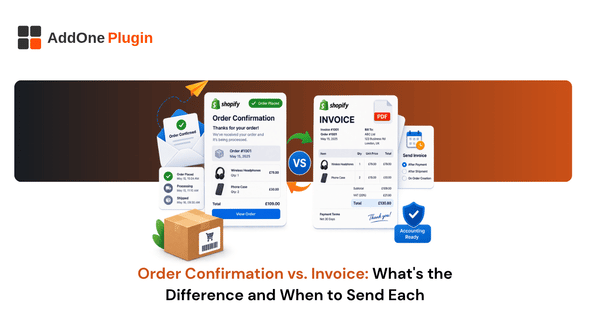
A customer asking for “the invoice” after already receiving an order confirmation email isn’t being difficult, they’re pointing out that the email they got doesn’t actually do what an invoice needs to do. The two documents look similar enough on the surface, both arrive by email, both list what was bought, that it’s easy to assume one covers the other. It doesn’t, and the gap between them shows up at exactly the wrong moment: when a customer or their accounting department needs a real financial document and gets a receipt-style summary instead. Understanding the difference isn’t just a compliance exercise either; it directly affects how many follow-up emails your support team ends up handling. This guide covers what separates an order confirmation from an invoice, and when your Shopify store should be sending each.
What Is an Order Confirmation?
An order confirmation is the first message a customer gets after checking out, and its entire job is reassurance, not billing.
Purpose: Confirming the Order Was Received
An order confirmation exists to tell the customer their order went through successfully: what they bought, the quantity, the total charged, and typically an order number for future reference. It’s a transactional acknowledgment, generated automatically the moment payment is captured, and its purpose ends there. Customers expect it within seconds of checking out, and its main job is peace of mind rather than documentation.
What It Typically Includes and What It Leaves Out
A standard order confirmation includes the order number, item list, quantities, prices, shipping address, and estimated delivery information. What it generally doesn’t include, at least not in a form built for accounting purposes, is a formal invoice number sequence, the seller’s full business and tax registration details, or a VAT or GST breakdown structured the way a compliant invoice needs to be. It’s built to reassure a consumer, not to satisfy an accounts payable process, and trying to read it as one leaves several required fields missing.
What Is an Invoice?
An invoice is a formal financial and legal document, and the requirements around it are considerably stricter than anything an order confirmation needs to meet.
Purpose: A Formal Record for Payment and Tax
An invoice is the document that records a transaction for accounting and tax purposes. It carries a sequential invoice number, the seller’s and buyer’s full legal details, a breakdown of VAT or GST where applicable, and payment terms if the transaction isn’t paid in full upfront. Unlike an order confirmation, an invoice is the document your customer’s bookkeeper actually needs to file, and the document a tax authority expects to see if either party is ever audited.
The Fields That Make an Invoice Legally Different
The specific fields required vary by country, but most VAT and GST regimes require an invoice number that follows a consistent sequence, the date of issue, both parties’ business names and addresses, a description of goods or services, the VAT or GST rate and amount applied, and the seller’s tax registration number. An order confirmation missing even one of these fields isn’t a lesser invoice, it’s simply not an invoice at all in the eyes of most tax authorities, regardless of how complete it looks to the customer reading it. A sequential invoice numbering scheme in particular is something order confirmations rarely have, since order numbers are typically generated by the ecommerce platform and don’t necessarily follow the gapless sequence most tax authorities expect from a proper invoice series.
The Practical Difference: What Happens If You Only Send One
Sending only an order confirmation and calling it done works fine for casual retail, right up until a customer needs to do something official with the document.
Why a B2B Customer Can’t Use an Order Confirmation for Their Books
A business customer’s accounting team generally can’t record an order confirmation as a valid purchase for VAT reclaim or expense purposes, since it lacks the formal fields their own compliance requires. This is precisely the moment a B2B buyer emails asking for “the actual invoice,” having already received your order confirmation and found it insufficient for their bookkeeping, which turns a routine purchase into an unnecessary back-and-forth for both sides. For a business ordering regularly from your store, this same friction repeats on every single order until the underlying gap is fixed, rather than resolving itself after the first request.
Why a Consumer Sometimes Needs More Than a Receipt Too
Even outside B2B, a consumer occasionally needs a proper invoice rather than an order confirmation, most commonly for expense reimbursement through an employer, a warranty claim, or an import VAT reclaim on a cross-border purchase. Assuming every retail customer is satisfied with an order confirmation alone misses this group, even if they’re a minority of your overall order volume, and it’s a group that tends to notice and remember when a store can’t produce a proper invoice on request.
When to Send Each Document
The two documents aren’t competing options, they’re meant to work together at different points in the order lifecycle.
Order Confirmation: Immediately at Checkout
The order confirmation should go out automatically the moment an order is placed and payment is captured, functioning as the instant “yes, this worked” message every ecommerce checkout is expected to provide. Speed matters more than completeness here; a customer wants confirmation within seconds, not a fully formatted financial document, and delaying it to add invoice-level detail just makes the confirmation itself feel slow.
Invoice: At the Point That Matches Your Business Model
For most retail stores, sending the invoice alongside or shortly after the order confirmation, generated automatically from the same order data, covers the requirement cleanly. For B2B and wholesale sellers using payment terms, the invoice timing often needs to match the agreed terms rather than the moment of purchase, particularly for net-terms orders where payment happens well after the goods ship, in which case the invoice functions as the actual payment request rather than simply a record of a completed transaction.
Automating Both Without Confusing the Two
The cleanest setup treats order confirmations and invoices as genuinely separate documents rather than trying to stretch one template to cover both jobs.
Why One Template Trying to Do Both Jobs Usually Fails
A single email template that tries to double as both an order confirmation and a compliant invoice tends to satisfy neither job well: too sparse to function as a real invoice, and too cluttered with formal fields to read as a quick, reassuring confirmation. Keeping them as two distinct, purpose-built documents, even if they’re sent close together or in the same email, avoids this compromise and gives each document room to do its actual job well.
How InvoiceForge Generates the Invoice Half Automatically
InvoiceForge generates the properly formatted, sequentially numbered invoice from your Shopify order data, separately from Shopify’s native order confirmation email, so your customers get both documents doing their intended jobs rather than one document trying to stretch across both. For B2B sellers specifically, our guide on auto-sending VAT invoices to B2B customers covers how to automate the invoice delivery side of this without manual work on every order, which matters most once order volume grows past the point where generating invoices by hand is realistic.
Two Documents, Two Jobs
An order confirmation and an invoice look similar enough to blur together, but they’re built for different audiences and different purposes: one reassures a customer their order worked, the other satisfies a legal and financial record-keeping requirement. Sending only the confirmation works until it doesn’t, usually the moment a B2B buyer or a VAT-conscious consumer needs a real invoice and finds themselves emailing to ask for one. Setting both up to fire automatically, from the same order data but as genuinely distinct documents, closes that gap before it becomes a support ticket, and it costs very little to set up once compared to fielding the same request repeatedly, order after order, for as long as the gap goes unaddressed. For the retail side of this same distinction, our breakdown of B2B invoice versus retail receipt covers a closely related comparison worth understanding alongside this one.