
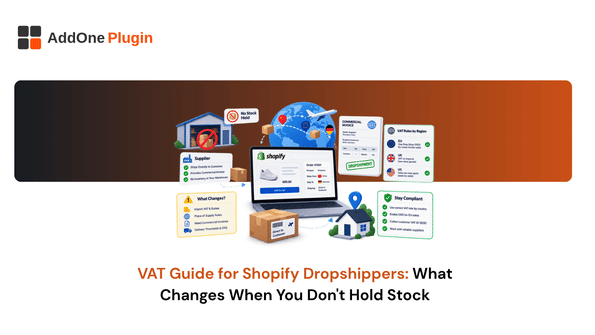
Not holding stock doesn’t mean not holding VAT liability, and that’s the assumption that gets new dropshippers into trouble faster than almost anything else. The fact that a supplier ships directly to your customer, without the product ever passing through your hands, changes very little about who owes VAT on the sale, even though it feels intuitively like it should. This guide covers how VAT actually works when you’re dropshipping, where the common misconceptions sit, and what it means for the invoices your Shopify store needs to issue.
Why Not Holding Stock Doesn’t Remove Your VAT Liability
The core misconception in dropshipping VAT is treating the supplier’s physical role in the transaction as if it were also their tax role, when in most cases the two are entirely separate questions with entirely separate answers.
You’re the Retailer of Record, Regardless of Who Ships the Product
In a dropshipping arrangement, you’re generally the retailer of record for VAT purposes, meaning you’re responsible for the VAT due on the sale to your end customer, even though your supplier is the one physically shipping it and may be handling import formalities on their own end. Your supplier’s location and VAT status affect your costs and your paperwork, but they don’t transfer your VAT obligation to your customer or to the supplier by default. This holds true even when your supplier is based overseas and you’ve never seen or touched a single unit of the product you’re selling.
Place of Supply Rules Still Apply the Same Way
VAT liability follows place of supply rules regardless of your stock model. If you’re VAT-registered and selling to consumers in a country where VAT applies, that obligation exists whether the product ships from your own warehouse or from a supplier’s warehouse on the other side of the world. The dropshipping model doesn’t create a new VAT category; it just adds an extra party to a transaction that VAT rules already know how to handle. Tax authorities generally don’t distinguish between a retailer who holds stock and one who doesn’t when determining who owes VAT on a sale to a consumer, since the legal relationship with the customer is what matters, not the physical fulfillment arrangement behind it.
Import VAT: Who Actually Pays It
This is where dropshipping introduces genuine complexity, since goods often cross an international border between your supplier and your customer that wouldn’t exist in a traditional retail model where you hold your own stock domestically.
The Importer of Record Determines Who’s Liable
Whoever is named as the importer of record on the customs declaration is responsible for paying import VAT and duties at the border. If your business is listed as the importer, you’re liable. If your customer ends up as the importer of record, which happens more often than dropshippers expect when a supplier ships directly, your customer becomes responsible for paying import VAT before the parcel is released to them, sometimes without any warning that a charge is coming. Which party ends up as importer of record often comes down to how your supplier’s shipping process is configured, which means it’s worth confirming directly with your supplier rather than assuming.
Why This Creates a Bad Customer Experience If Left Unmanaged
A customer who ordered from your Shopify store and then gets an unexpected import VAT bill from a courier before they can collect their parcel is a customer having a bad experience with your brand, regardless of whose technical liability it was under customs rules. This is one of the most common causes of dropshipping refund requests and negative reviews, and it’s entirely preventable with the right registration and checkout setup. From the customer’s perspective, they paid you once at checkout and are now being asked to pay again to receive what they already bought, which reads as a bait and switch even when it’s a genuine customs mechanic rather than anything deliberate on your part.
Using IOSS and OSS to Simplify Cross-Border Dropshipping
For dropshippers selling into the EU, two schemes exist specifically to prevent the surprise-charge problem at the customer’s door, and picking the right one for a given order depends entirely on where the goods physically are at the moment of sale.
IOSS for Low-Value Imported Goods
The Import One Stop Shop lets you charge VAT at the point of sale for goods valued at €150 or less, then remit it through a single monthly IOSS return, rather than leaving your customer to pay import VAT and handling fees when the parcel arrives. This is the scheme most relevant to typical dropshipping order values, since a large share of dropshipped products fall under that €150 threshold. Registering for IOSS as a non-EU business generally requires appointing an EU-based intermediary to handle the declarations and payments on your behalf, which is an added step but a manageable one compared to the alternative of registering for VAT separately in every EU country you ship into.
OSS for Goods Already Inside the EU
If your dropshipping supplier holds stock inside the EU rather than shipping from outside it, the goods are already in free circulation and OSS, not IOSS, becomes the relevant scheme for reporting VAT on cross-border sales to EU consumers. Getting this distinction right matters because IOSS and OSS have different thresholds, different registration processes, and cover fundamentally different supply chains, even though both are aimed at simplifying the same underlying problem of cross-border VAT reporting. A dropshipper working with multiple suppliers, some based inside the EU and some outside it, may genuinely need both schemes running in parallel depending on where each individual order actually ships from.
What This Means for Your Shopify Invoices
None of the VAT mechanics matter to your customer if the invoice they receive doesn’t reflect what actually happened with their order.
Your Invoice Still Needs to Show VAT Correctly
Regardless of where your supplier ships from, the invoice your business issues to the end customer needs to show the correct VAT treatment for that sale, whether that’s VAT charged under IOSS, VAT charged under your domestic registration, or a note explaining that import VAT will be collected separately at the border. Skipping this because “the supplier handles shipping” leaves your customer with an invoice that doesn’t match what they’ll actually experience with their delivery, and a customer who receives a customs bill that contradicts what their invoice implied is far more likely to escalate the complaint than one who was told upfront what to expect.
Keeping VAT-Compliant Records When You Never Touch the Product
Not physically handling the product doesn’t reduce your record-keeping obligation. You still need invoices showing the correct VAT treatment, retained for the full retention period your market requires, regardless of the fact that the goods moved directly from supplier to customer. InvoiceForge generates these invoices from your Shopify order data directly, applying the correct VAT treatment based on your store’s configuration, which keeps this consistent even when your supply chain is more complex than a standard single-warehouse setup, and even when you’re working with several suppliers shipping from several different countries at once.
Building a Dropshipping VAT Setup That Doesn’t Surprise Customers
The dropshipping model doesn’t change who owes VAT, it just adds a supplier in the middle of a transaction that VAT rules were already built to handle. The real risk isn’t a misunderstanding of the law; it’s a checkout and invoicing setup that doesn’t account for the extra border crossing a dropshipped order often involves. Register for IOSS if your order values sit under the EU threshold, understand who’s actually the importer of record on your shipments, and make sure your invoices reflect the real VAT treatment rather than a generic template that assumes a simpler supply chain. None of this requires becoming a customs expert; it requires knowing which two or three facts about your specific supply chain determine the answer, and checking them once rather than assuming a standard retail VAT setup automatically covers a dropshipping arrangement. For the broader mechanics of how EU cross-border VAT reporting works once you’re registered, our EU OSS VAT scheme guide covers the reporting side in more depth, and our VAT invoice guide for UK, EU, and Australia sellers covers what a compliant invoice needs to show across your core markets.