
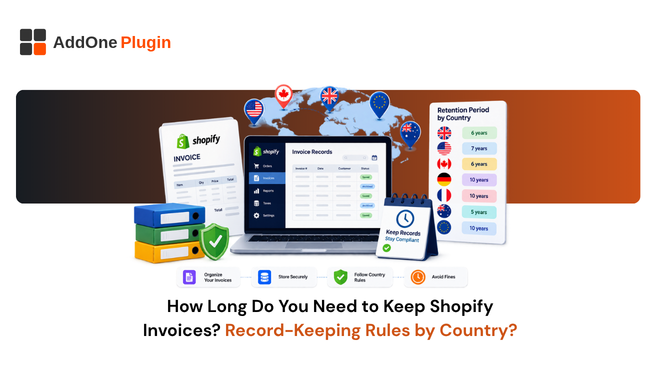
An HMRC or ATO audit doesn’t ask about invoices from last month, it asks about invoices from years ago, and “I think we deleted those” is not an acceptable answer. Every country your Shopify store sells into sets its own minimum period for how long you need to keep invoice records, and the periods don’t line up, which means a merchant selling across the UK, Germany, and Australia is technically juggling three separate deletion dates for what might be the exact same order. Most merchants only think about retention the moment they’re asked to produce something old, which is precisely the wrong time to discover a gap. This guide covers how long to keep invoices in the UK, Germany, and Australia, what format those records need to be in, and how to build a retention habit that doesn’t depend on remembering the rules every time.
Why Invoice Retention Matters for Shopify Merchants
Invoice retention isn’t a filing formality, it’s your evidence if a tax authority ever questions a transaction years after the fact. It’s also, less dramatically, useful for your own business: a dispute with a customer, a warranty claim, or a simple question about what was actually sold and when can all hinge on being able to pull up the original invoice quickly.
What Happens If You Can’t Produce an Invoice on Audit
If a tax authority audits your business and asks for an invoice you can’t produce, the consequences range from disallowed deductions to denied VAT reclaims to financial penalties, depending on the jurisdiction and the scale of the gap. In the more demanding regimes, deliberately destroying required records can escalate well beyond a fine. Even an honest gap, a hard drive failure or a switch between invoicing apps that didn’t carry historical records forward, tends to be treated the same way an intentional gap would be during an audit, since the burden is on the business to prove the record existed and was properly kept.
Retention Applies to Both Issued and Received Invoices
It’s easy to think of retention as only covering the invoices you send to customers, but the requirement runs both ways. Invoices you receive from suppliers, for VAT reclaim purposes and general expense records, carry the same retention obligation as the invoices you issue.
How Long to Keep Invoices, Country by Country
The three markets InvoiceForge is built around each set a different minimum, and none of them match each other.
United Kingdom: 6 Years From the End of the Accounting Period
HMRC requires UK businesses to keep VAT records, including invoices, for at least 6 years from the end of the accounting period they relate to. This covers both sales and purchase invoices, and the clock starts at the end of the period, not the date on the invoice itself. If an invoice relates to a transaction that spans more than one accounting period, or if a specific HMRC scheme you’re using sets a longer requirement, the 6-year minimum can extend further, so it’s worth treating it as a floor rather than a fixed number.
Germany: 8 Years Under the 2025 Rule Change
Germany’s retention period for invoices and accounting vouchers was shortened from 10 years to 8 years under the Fourth Bureaucracy Relief Act, which took effect for records whose retention period hadn’t already expired by January 2025. The rules themselves live in the GoBD principles, and the retention clock starts at the end of the calendar year the invoice was created, not the date on the document. Older invoices whose 10-year clock had already started before the rule changed still run out under the original schedule, which means a German-facing merchant may be holding two different retention timelines side by side for a while as older stock works its way through the system.
Australia: 5 Years Per ATO Rules
The Australian Taxation Office requires most business records, including invoices, to be kept for 5 years from when the record was prepared or the transaction it relates to was completed. In practice, most Australian businesses count 5 years from the end of the relevant financial year to keep the calculation simple, since that period lines up with how long the ATO generally has to review and amend a past assessment. Once that window closes, the ATO typically can’t reopen your tax position for that period, which is the practical reason the 5-year figure exists in the first place.
What Format Do Retained Invoices Need to Be In?
Meeting the time requirement isn’t enough on its own. The format the record is stored in matters just as much, particularly in Germany.
Digital vs Paper Record Requirements
In most jurisdictions, digital records are acceptable as long as they remain legible, complete, and retrievable for the full retention period. What’s not acceptable is a format that becomes unreadable over time, or a storage system that gets decommissioned partway through the retention window with no migration plan. PDFs tend to be the safest default across all three markets, since the format is stable, widely readable, and generally accepted as a faithful, unalterable copy of the original invoice.
Germany’s GoBD Machine-Readability and Immutability Rules
Germany goes further than most. Under GoBD, records need to stay machine-readable and provably unaltered for the entire retention period, and if you receive a structured e-invoice in XML format, you’re required to store the original XML, not just a PDF printout of it. A converted or reformatted copy without the original preserved doesn’t satisfy the rule. German auditors have specifically flagged this as one of the most common compliance failures they encounter, since it’s an easy step to miss when a business assumes any readable copy of an invoice is good enough.
Keeping Exportable, Audit-Ready Invoice Records on Shopify
Shopify’s own order history was built for running a store day to day, not for surviving a multi-year audit request.
Why Shopify’s Native Order History Isn’t a Retention System
Shopify keeps a record of your orders, but that’s a different thing from a compliant invoice archive. There’s no guarantee that what displays in your admin years from now matches the invoice format a given country’s tax authority expects, and orders themselves aren’t structured with retention deadlines in mind. If you ever change themes, migrate platforms, or simply lose access to an old app, an order history view that depends on that app staying installed and functional isn’t something you can rely on eight years later.
How InvoiceForge Stores and Exports Compliant Invoice Archives
InvoiceForge generates and stores a proper invoice record for every order at the time it’s created, which is the foundation of a usable retention archive. If your retention plan depends on pulling a large batch of historical invoices in one go, for example during an audit or a store migration, we’d recommend confirming directly with the InvoiceForge team what your plan’s current export limits are before you need it under pressure, rather than assuming unlimited bulk export is included by default.
Building a Simple Retention Policy Across Markets
A retention policy that tries to track three different country rules separately is a policy nobody follows consistently.
Setting One Retention Period That Covers Your Longest Requirement
The simplest approach for a merchant selling into the UK, Germany, and Australia is to retain every invoice for 8 years, matching Germany’s requirement, which automatically satisfies the UK’s 6-year and Australia’s 5-year minimums as well. It’s easier to apply one rule to everything than to track three separate deletion dates across markets, especially once order volume grows and manually sorting invoices by destination country to apply different retention rules stops being realistic.
What to Do When You Close or Migrate Your Store
Before closing a store or switching invoicing apps, export a full copy of your invoice archive while you still have access, and store it somewhere independent of the platform itself, such as your own cloud storage. A retention obligation doesn’t end just because the tool you used to generate the invoices is no longer active on your account, and tax authorities generally aren’t sympathetic to “the app we used shut down” as an explanation for a missing record.
A Retention Habit, Not a Once-a-Year Scramble
Invoice retention rewards businesses that treat it as a background setting rather than a task on a to-do list. Once your invoices are generated correctly and stored somewhere reliable, the retention period is just a matter of not deleting anything, not an active piece of ongoing work. The merchants who run into trouble here are almost never the ones who deliberately ignored the rules; they’re the ones who never set a policy in the first place and only discovered the gap when a specific old invoice was requested and nowhere to be found. Set it up once against your strictest market’s requirement, per the VAT invoice guide for UK, EU, and Australia sellers, and you won’t have to think about it again until an auditor asks.