
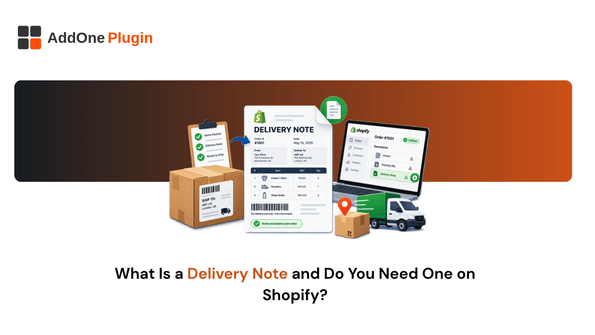
Ask three people in ecommerce to define a delivery note and you’ll likely get three overlapping but slightly different answers, and at least one of them will call it a packing slip instead. The confusion isn’t really anyone’s fault; these documents genuinely do overlap in most small businesses, and the distinction only starts to matter once you’re shipping into markets or customer types where it’s expected to matter, at which point getting it wrong looks like a gap in your process rather than a harmless naming quirk. This guide covers what a delivery note actually is, how it differs from a packing slip and an invoice, and when a Shopify store genuinely needs one.
What Is a Delivery Note, Exactly?
A delivery note is a document that travels with a shipment and confirms what was sent, without asking the recipient to pay for anything. It sits alongside the packing slip and the invoice as one of three related but distinct documents that can accompany a single order.
The Core Purpose: Proof of Dispatch, Not a Payment Request
A delivery note lists the items included in a shipment, their quantities, and typically a reference back to the original order or invoice number, but it deliberately leaves out pricing. Its job is to confirm what was shipped and, in many cases, to be signed by the recipient as proof that the delivery was accepted, which is the detail that most clearly separates it from a plain packing slip. It’s sometimes called a dispatch note or a goods received note in different regions or industries, but the underlying document is the same regardless of the name attached to it.
Delivery Note vs Packing Slip: The Signature Difference
In casual use, “delivery note” and “packing slip” get used interchangeably, and in a lot of small operations, they genuinely are the same document. Where a distinction exists, a packing slip is narrower in scope, listing the physical contents of one specific package so warehouse staff and the recipient can verify what’s inside, while a delivery note is the broader document covering the entire order and often includes a signature field for the recipient to confirm receipt. When an order ships across multiple boxes, each box might carry its own packing slip, while the whole shipment has one delivery note. In practice, plenty of suppliers combine both into a single document, which is perfectly workable for most businesses and only becomes a problem if a customer or a specific market expects the two kept separate.
Delivery Note vs Invoice: Why the Two Get Confused
The confusion between a delivery note and an invoice is more consequential than the packing slip mix-up, since one of these documents asks for money and the other doesn’t, and mixing them up in front of a customer is a much bigger misstep than mixing up two documents that both simply confirm contents.
What a Delivery Note Deliberately Leaves Out
A delivery note contains the list of items delivered and contains no pricing details at all, since its purpose is verification, not billing. An invoice, by contrast, is a payment request, and it needs prices, VAT or GST treatment, and payment terms included, none of which belong on a delivery note. Putting pricing on a document meant to be signed by a warehouse worker or receiving clerk also creates an unnecessary confidentiality issue, since that person rarely needs or should have visibility into what the customer is being charged.
Who Receives Each Document
This distinction matters most when the person receiving the goods isn’t the person paying for them, which happens constantly in B2B, and rarely comes up at all in a typical direct-to-consumer sale. A delivery note goes to whoever physically receives the shipment, often a warehouse or goods-in team, while the invoice goes to the accounts payable department, who may never see the physical goods at all. Sending only an invoice with a shipment and skipping the delivery note leaves the receiving team with no document to check the delivery against, which is exactly the gap a delivery note exists to close. The reverse problem is just as common: a delivery note without a corresponding invoice reference leaves the accounts team unable to match what was delivered against what they’re being billed for.
Do You Actually Need One on Shopify?
Whether a delivery note is worth adding to your process depends heavily on who your customers are and where they’re located, more than it depends on any hard legal requirement.
When B2B and Wholesale Orders Make Delivery Notes Worth Adding
Delivery notes earn their keep most clearly in B2B and wholesale contexts, where the receiving business’s goods-in team needs a document to check the shipment against, separate from whatever their accounts team does with the invoice. If your Shopify store sells to businesses that expect a formal receiving process, a delivery note is often assumed rather than requested, and its absence can read as an unusually informal operation. Larger buyers in particular tend to have their own internal goods-received procedures that depend on a supplier providing this document as standard practice, not as a special request.
When Retail Orders Can Skip It Entirely
For a standard retail order shipped directly to an individual consumer, a delivery note is rarely expected and rarely missed. A packing slip inside the box, confirming what’s included, generally covers everything a retail customer needs, and adding a formal delivery note with a signature field on top of that is more process than the transaction calls for. Retail customers also aren’t in a position to sign and return a delivery note in the way a warehouse receiving clerk would, which makes the signature field, the whole point of a delivery note in a B2B context, essentially meaningless for a home delivery.
What Should Be on a Proper Delivery Note
If you decide a delivery note is worth adding to your workflow, a few fields make it functional rather than just another piece of paper in the box, and skipping any of them undermines the whole point of having the document.
Essential Fields: Reference Numbers and Itemized Contents
A usable delivery note needs a unique delivery note number, the sender’s and recipient’s names and addresses, the delivery date, an itemized list of goods with quantities and descriptions, and a reference back to the original order or invoice number so the two documents can be reconciled later. Carrier name and tracking number are worth including too, particularly for shipments where proof of dispatch might matter later in a dispute. Leaving out the cross-reference to the invoice number is a surprisingly common mistake, and it’s the one that causes the most friction later, since it’s exactly what a receiving team needs to match a delivery against the bill their own accounts department is holding.
The Signature Field and Why It Matters for B2B Disputes
The signature field is what gives a delivery note its evidentiary weight. A signed delivery note is legal proof that a specific set of items was delivered and accepted on a specific date, which becomes genuinely useful if a customer later disputes receiving an order, or disputes receiving it in full. Without that signed record, a delivery dispute comes down to one party’s word against the other’s, which is a weak position to be in if a customer withholds payment on the grounds that part of an order never arrived.
Making the Decision for Your Store
A delivery note isn’t a document every Shopify store needs, but it’s also not purely a legacy paper-trail habit either. If your customer base is primarily B2C retail, a packing slip inside the box covers what your customers expect, and a formal delivery note adds process without adding value. If a meaningful share of your orders go to wholesale or B2B accounts with their own receiving procedures, adding a proper delivery note, distinct from both your packing slip and your invoice, closes a gap those customers likely already expect you to have covered. The decision really comes down to who’s on the other end of the shipment: a home address rarely needs it, a loading dock usually does. For the invoice side of that same order, our breakdown of the B2B invoice versus retail receipt distinction covers the payment document half of the picture, and our guide to Shopify packing slip templates is the right next stop if what you actually need is the narrower, contents-focused document rather than a full delivery note.