
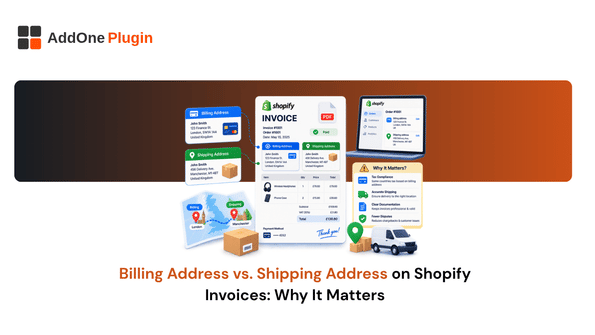
Two address fields sitting quietly at checkout look like a formality until the wrong one ends up driving a tax calculation it was never meant to control. Billing address and shipping address serve genuinely different purposes on an invoice, and which one governs which decision depends on what kind of tax you’re dealing with and what kind of product you’re selling. Most merchants never think about the distinction until a specific order exposes it, usually a B2B customer whose invoice doesn’t reclaim VAT correctly or a tax calculation that looks wrong for reasons nobody can immediately explain. This guide covers what each address is actually for, where they diverge, and why getting the distinction right matters more than it looks like it should.
What Each Address Is Actually For
Before getting into tax rules, it helps to be clear that billing and shipping addresses answer two completely different questions, and most of the confusion around them comes from assuming they’re really just one question asked twice at checkout.
Billing Address: Who’s Paying and Where They’re Registered
The billing address is tied to the customer’s payment method, used by payment processors to verify the cardholder’s identity and reduce fraud through address verification checks. On an invoice, it also typically represents the legal entity being billed, which matters enormously in B2B, where the person receiving a shipment and the company paying for it are often not the same address at all. A regional sales rep might place an order that ships to their local office, while the invoice needs to go to the company’s central accounts payable address for payment to actually happen.
Shipping Address: Where the Goods Physically Go
The shipping address is simply the physical destination for the order, used by carriers and fulfillment systems to route the package correctly. It has no inherent connection to who’s paying or which business entity is responsible for the invoice; it just answers “where does this box need to end up,” and for most consumer orders, that’s the entire extent of its role, with no tax or billing consequence attached to it at all.
How Each Address Affects Tax Treatment
This is where the distinction stops being administrative and starts affecting what a customer actually owes, and it’s also where getting it wrong stops being a cosmetic error and starts being a compliance one.
VAT and the Delivery Location for Goods
For EU VAT purposes, the place of supply for goods generally follows where the goods are delivered, not the billing address on file. An order billed to a company’s head office in one country but shipped to a branch office in another can trigger different VAT treatment based on the shipping destination, regardless of which address appears as the “bill to” on the invoice. This is a common blind spot for merchants who assume that whichever address the customer entered first, usually billing, is the one that determines the tax rate applied, when in fact the two fields can point to entirely different tax jurisdictions on the same order.
US Sales Tax and the Destination Rule
US sales tax works similarly for physical goods in the large majority of states, which are destination-based: tax is calculated according to where the customer takes possession of the product, meaning the shipping address, not the billing address, drives the calculation. The billing address only steps in as a fallback when no shipping address is available at all, such as for a purely digital product with no physical delivery. A handful of origin-based states are the exception, charging tax based on the seller’s location for in-state sales, but destination-based rules cover the majority of US ecommerce transactions, which makes shipping address the safer default assumption for a store selling primarily physical goods across state lines.
Digital Goods and Services: Billing Address Takes Over
The rule flips for digital products and services in many jurisdictions. Without a physical shipping destination to anchor the transaction, tax authorities often fall back to the billing address, or the customer’s stated location of use, to determine which jurisdiction’s tax rate applies. A store selling both physical and digital products needs its tax logic to switch between these two rules correctly depending on what’s actually in the cart, which is a genuinely different calculation path for what might look, from the checkout screen, like the same kind of order, and a mixed cart with both product types can require applying both rules within a single transaction.
Why B2B Invoices Need Both Addresses Correct
For B2B orders specifically, getting only one of the two addresses right isn’t good enough, since each one serves a purpose the other can’t cover, and treating them as interchangeable is where a lot of avoidable VAT reclaim problems originate.
The Employee-Ordering Problem
A common compliance failure happens when an employee orders supplies to their home address but the invoice ends up addressed to them personally rather than to their employer. When that happens, the company can’t reclaim VAT on the purchase, since the invoice doesn’t name the actual business as the customer of record, even though the company is the one ultimately paying. Getting the billing address right as the company’s legal entity, regardless of where the goods physically ship, is what preserves the VAT reclaim, and it’s a fix that costs nothing beyond making sure the checkout form is filled in correctly the first time.
Why the Shipping Address Still Needs to Be Accurate Too
None of this makes the shipping address optional. A correct billing address with a wrong shipping address just means an accurately invoiced order that never arrives at the right place, which is arguably a worse outcome for a business customer than a billing error, since it stalls their operations rather than just their bookkeeping. Both fields need to be captured and displayed correctly on the invoice, doing their own separate jobs, rather than treating one as a stand-in for the other.
Getting This Right on Your Shopify Invoices
Most of the friction here comes from checkout flows or invoice templates that only capture or display one address, assuming it covers both purposes when in practice it rarely does for anyone ordering on behalf of a business.
Capturing Both Addresses Distinctly at Checkout
Shopify’s checkout supports separate billing and shipping address fields natively, and B2B or wholesale customers in particular should be encouraged to fill in both accurately rather than defaulting one to match the other out of convenience. This matters most for repeat business customers ordering to varied delivery locations, such as multiple branch offices, from a single centrally billed account, where the shipping address changes order to order while the billing address should stay consistent.
Displaying Both Correctly on the Invoice Itself
A compliant invoice for a physical goods order should clearly show both the billing address, identifying who’s being charged, and the shipping address, confirming where the goods went, particularly when the two differ. InvoiceForge captures both fields from the underlying Shopify order and displays them distinctly on the generated invoice, so the document reflects the actual transaction rather than collapsing two different pieces of information into one address field, which is exactly the kind of shortcut that causes VAT reclaim problems for customers down the line.
Two Fields, Two Jobs, One Compliant Invoice
Billing and shipping addresses aren’t redundant fields asking the same question twice. One identifies who’s financially responsible for the order, and the other determines where it physically goes, and depending on whether you’re dealing with VAT, US sales tax, or a digital product, either one might be the address that actually drives the tax calculation. Getting both captured accurately and displayed clearly on the invoice avoids the two most common failure modes: a business that can’t reclaim VAT because the wrong entity was billed, and a shipment that goes to the wrong place because the delivery address was never distinguished from the payer’s address. Neither failure is dramatic on its own, but both are the kind of small, recurring friction that adds up across a growing B2B customer base. For the broader question of what else needs to appear correctly on a compliant invoice, our VAT invoice guide for UK, EU, and Australia sellers covers the full set of required fields.