
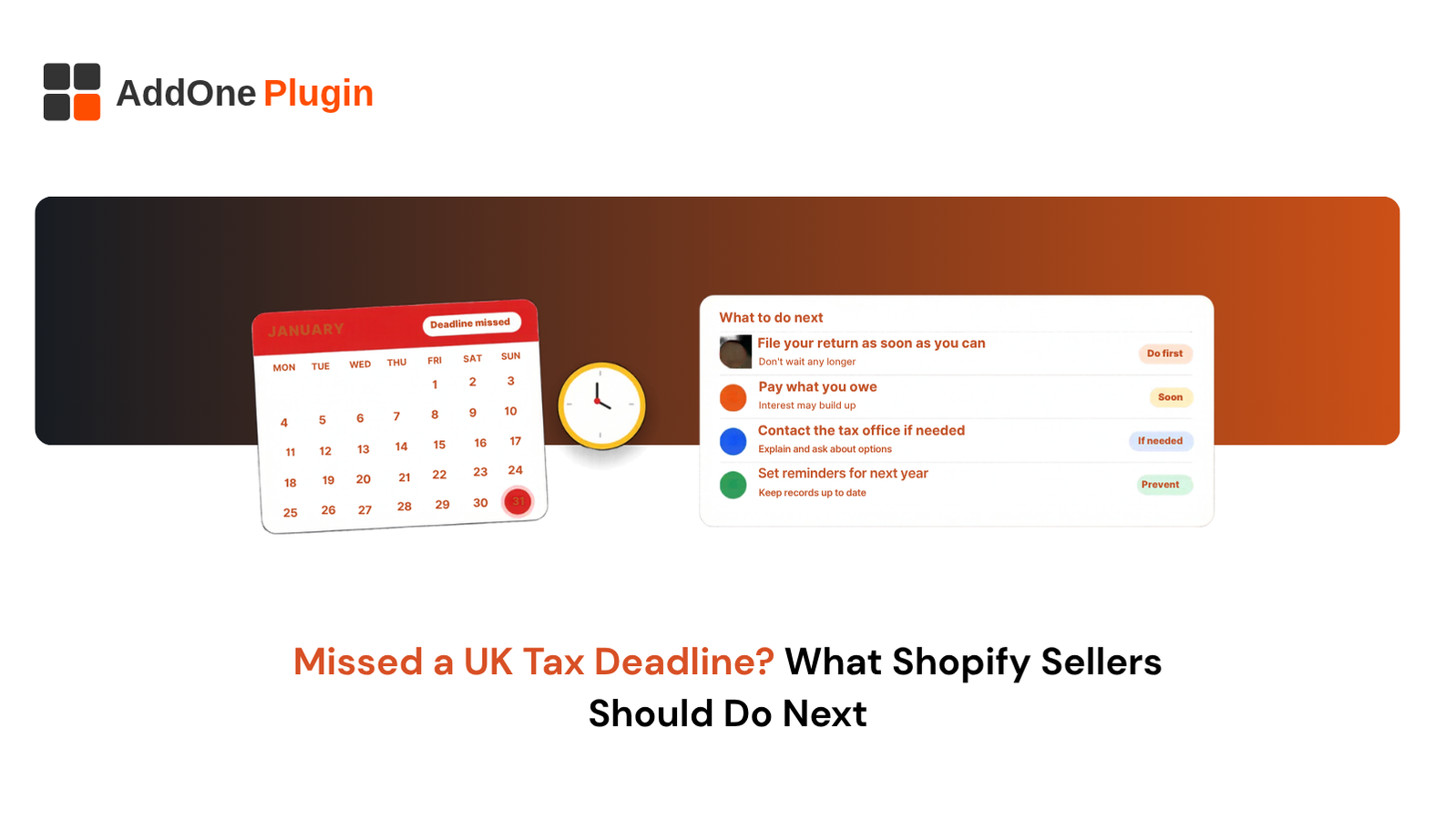
You spot an HMRC email and realise a filing date slipped past. A missed UK tax deadline feels serious, but it is rarely the end of the road. Penalties follow clear rules, they grow with delay, and acting quickly limits them.
This guide helps Shopify sellers work out which deadline they missed, understand the penalties, take the right first steps and appeal when they have a valid reason. We also show how clean store data makes the next deadline painless. Figures come from GOV.UK and Companies House pages checked in October 2026. We are not accountants, so treat this as a map, not a verdict.
Missed a UK Tax Deadline? Work Out Which One You Missed
Start by naming the filing: a Self Assessment return (sole traders), a VAT return or payment, or Corporation Tax and Companies House accounts (limited companies). Each has its own deadline, penalty and appeal route. Check your HMRC online account or the Companies House filing history, then match the date.
Self Assessment (Sole Traders)
Sole traders face three kinds of date. You must tell HMRC by 5 October after the tax year in which you started trading, if you need a tax return and have not filed one before. A paper return is due by 31 October after the end of the tax year, and an online return and payment are due by 11:59pm on 31 January. For the 2025-26 tax year, those dates are 31 October 2026 and 31 January 2027.
If you register after 5 October, HMRC sends you a letter or email with a different return deadline, set at 3 months from the date on it. The payment date stays at 31 January. If you make payments on account towards your bill, there is a second payment date of 31 July. Check which of these you missed.
VAT Returns and Payments
VAT-registered sellers file a return for each accounting period, usually every 3 months. The deadline for submitting online is usually one calendar month and 7 days after the period ends, and that is also the payment deadline. You must submit a return even when you have no VAT to pay or reclaim, and returns go through software that works with Making Tax Digital for VAT.
Your VAT online account shows the exact dates for your business, so check there first. Note whether you filed late, paid late or both, because the two carry different penalties.
Corporation Tax and Companies House Accounts (Ltd)
Limited companies deal with two regulators. Annual accounts go to Companies House 9 months after the financial year ends, and first accounts are due 21 months after registration. For profits of up to £1.5 million, Corporation Tax is payable 9 months and 1 day after the accounting period ends, and the Company Tax Return is due 12 months after it ends.
A confirmation statement is due at least once every 12 months. Each missed date carries its own penalty, so list every one that slipped.
What Penalties Apply After a Missed UK Tax Deadline?
Penalties depend on the tax. Self Assessment returns start at a £100 penalty and escalate to daily charges, then percentage charges. Late Self Assessment payments add 5% charges plus interest.
VAT uses penalty points for late returns and percentage penalties for late payment. Companies face HMRC penalties for late tax returns and separate Companies House penalties for late accounts.
Late Filing Penalties and How They Escalate
For a late Self Assessment return, HMRC applies this ladder:
- Initial penalty: £100.
- After 3 months: additional daily penalties of £10 per day, up to a maximum of £900.
- After 6 months: a further 5% of the tax due or £300, whichever is greater.
- After 12 months: another 5% of the tax due or £300, whichever is greater.
Each step stacks on the last, so file as soon as possible to stop the next one arriving. The GOV.UK Self Assessment penalties guidance also has a tool to estimate what you owe. You must pay a penalty within 30 days of the date on the penalty notice.
Late Payment Penalties and Interest
Pay a Self Assessment bill late and HMRC charges 5% of the unpaid tax at 30 days, 6 months and 12 months. Interest is charged on top of the amount owed, so paying as soon as you can limits the total.
HMRC’s late payment interest rate follows the Bank of England base rate and changes over time. We do not quote a figure here because it may be out of date by the time you read this. Check the current rate on the GOV.UK page for HMRC interest rates on late and early payments before you calculate what you owe.
Late VAT Returns: The Points-Based System
Each late VAT return earns a penalty point. The threshold depends on how often you file: 2 points for annual returns, 4 for quarterly and 5 for monthly. When you reach the threshold you receive a £200 penalty, then another £200 for each further late return while you remain at the threshold. Nil and repayment returns count, and you can read the full rules in HMRC’s guidance on penalty points and penalties for late VAT returns.
Late payment is separate, and HMRC charges late payment interest from the first day a VAT payment is overdue.
A first penalty applies once a payment is 16 or more days late, at 3% of the VAT outstanding at day 15. At 31 or more days, that first penalty rises to include 3% of what is still outstanding at day 30, and a second penalty builds daily at an annual rate of 10% on the outstanding balance. Contact HMRC early about a Time to Pay arrangement, which HMRC says can mean lower or no late payment penalties.
Why Penalties Differ for Ltd Companies
For a late Company Tax Return, HMRC charges £200 after 1 day and another £200 at 3 months. At 6 and 12 months, HMRC estimates your Corporation Tax bill and adds a penalty of 10% of the unpaid tax each time. If your return is late three times in a row, the £200 penalties rise to £1,000 each. You get these penalties even when there is no tax to pay.
Companies House penalises late accounts separately: £150 up to 1 month late, £375 for 1 to 3 months, £750 for 3 to 6 months and £1,500 beyond 6 months. The penalty doubles if your accounts are late in two successive financial years. A missed confirmation statement can bring a fine of up to £5,000 and the company can be struck off the register. Two regulators mean two separate appeals.
What Should You Do First After a Missed UK Tax Deadline?
File the late return as soon as you can, even if you cannot pay in full. Penalties keep growing while a return is outstanding. Then rebuild your records, check every penalty notice and contact HMRC about a payment plan. Waiting for perfect numbers costs more than filing with your best figures now.
File as Soon as Possible, Even If You Can’t Pay in Full
Filing stops the late filing ladder from climbing further. Unpaid tax still attracts late payment penalties and interest, so pay what you can alongside the return. If you do not know your final profit, use provisional figures and tell HMRC you did so when you submit. You then have 12 months from the Self Assessment deadline to correct the return, and if more tax is due you pay interest on the difference from the original due date.
A company must file its overdue Company Tax Return before it can appeal the late filing penalty, so filing first also protects your appeal.
Rebuild Missing Records From Shopify Payouts, Order Exports and Fee Reports
Your store holds most of the evidence you need. Pull these for the missing period:
- The payout report: gross sales, fees, refunds and net payouts.
- An orders export with discounts, shipping and tax collected.
- Fee reports from Shopify and other payment providers.
- Bank statements to match each payout.
- Invoices for ads, apps, stock and shipping.
Match every payout to a bank deposit, then total the period. Payout timing also shapes your cash position, which our guide to payment gateways and cash flow for Shopify B2B orders explores. Keep records for at least 5 years after the 31 January deadline for Self Assessment, and at least 6 years for VAT. If records are lost and you cannot replace them, do your best to provide figures and tell HMRC when you file that they are estimated or provisional.
Contact HMRC or Ask for a Time to Pay Arrangement
If you cannot pay in full, GOV.UK says you may be able to set up a payment plan to pay in monthly instalments. You can check eligibility online, and you will need your tax reference number, UK bank details for a Direct Debit and details of your income and spending. HMRC will check that the plan is affordable.
The monthly amount is based on what you have left after rent, food, utilities and fixed outgoings, and you are usually asked to pay around half of it. There is no fixed time limit on a plan, but paying faster means paying less interest. Ignore the debt and HMRC may use collection steps, including a debt collection agency, so read the GOV.UK guidance on what to do if you cannot pay your tax bill on time.
Can You Appeal a Late Filing Penalty?
Yes. You can challenge a penalty if you have a reasonable excuse or you think the penalty is wrong, and you usually have 30 days from the date the penalty was issued. HMRC decides each case on its facts, so no outcome is guaranteed. Send your overdue return or payment as soon as you are able, then submit your appeal with a clear explanation and evidence.
What Counts as a Reasonable Excuse
A reasonable excuse is something that stopped you meeting a tax obligation for a valid reason. GOV.UK lists examples such as:
- A partner or close relative died shortly before the deadline.
- An unexpected stay in hospital, or a serious or life-threatening illness.
- Computer or software failure while preparing an online return.
- Problems with HMRC online services.
- Fire, flood or theft, or unpredictable postal delays.
- Relying on someone else to send your return when they did not.
These will not be accepted: a payment that failed for lack of funds, finding the HMRC online system too difficult, not getting a reminder, or a mistake on your return. You must still file or pay as soon as you are able.
How and When to Appeal
Follow these steps:
- File the overdue return, or pay the overdue tax, as soon as you are able.
- Check the date on the penalty notice. You usually have 30 days from that date to contact HMRC or appeal.
- Use the right route. Self Assessment and other direct tax penalties follow the instructions on the penalty letter or the appeal form that came with it. VAT penalties come with an offer of a review, which you can accept through your VAT online account. Company Tax Return penalties use an online appeal form that you complete in one go, print and post. Companies House accounts penalties have their own online appeal service.
- Explain your reasonable excuse in your own words, including dates.
- Ask about paying. GOV.UK says that if you have appealed a penalty, you will not have to pay it until the appeal is settled.
Miss the 30 days and you must give a reason for the delay. Our guide on how to register a Shopify business in the UK explains which of these obligations apply to your structure.
What Evidence to Gather
Strong appeals rest on dates and documents. Gather the penalty notice date and amount, your tax reference and the period involved. Then collect proof of the excuse: doctor or hospital letters, screenshots of software errors, emails with an agent who failed to file, or repair invoices.
Build a short timeline of what happened and when you filed. For a Companies House appeal, any document you upload must include the full name of the person or company affected and the relevant dates. Companies House says appeals are unlikely to succeed if the company is dormant, you cannot afford to pay, you relied on your accountant or these were your first accounts, and you can appeal only once against a penalty notice.
If HMRC Rejects Your Appeal
A rejection is not final, and you keep your options. If HMRC does not change its decision, you are offered a review, and you have 30 days from the offer to accept it or appeal to the tax tribunal. Reviews usually take around 45 days and are usually quicker than tribunal appeals.
You may be able to delay paying tax that is in dispute, but interest can still be charged on it until it is paid. A complaint about how HMRC treated you follows a different route from an appeal. Ask a qualified adviser for help before a tribunal case, because the process is formal, and read the GOV.UK guidance on disagreeing with a tax decision or penalty.
How to Stay Compliant as a Shopify Seller
Most missed deadlines trace back to messy records, not bad intent. Fix the data flow and filing dates become routine. Every sale, fee and refund already sits in your Shopify admin. You only need to organise it.
Clean Sales, Fee and Refund Reporting From Your Store
Your accountant needs a few numbers each month: gross sales, discounts, refunds, shipping, tax collected, payment fees and net payouts. Set up one export routine and use it monthly, not once a year.
Reconcile each payout to your bank account and note anything that does not match. Refunds and chargebacks cause most gaps. Record the cause of each gap in a notes column, so a clean monthly reconciliation turns tax season from a scramble into a short check.
Automated Records and Invoices That Feed Your Accountant
Automate what you can. Connect your accounting software, schedule exports and keep supplier and ad invoices in one folder. Shopify can generate VAT invoices for eligible orders shipping to the UK or EU once you activate the feature. Customers can save or print them from their order pages, but Shopify does not email them automatically, so check how your customers actually receive them.
Your accountant also needs a clear export of every invoice number and VAT amount for the period. Our guide to VAT invoicing for digital products on Shopify lists the fields a VAT invoice must carry. Disclosure: InvoiceForge is our own Shopify app from Add One Plugins. It is a drag-and-drop PDF invoice builder for Shopify with branded templates, conditional VAT/GST fields, bulk PDF generation, and automatic invoice emails triggered by order status changes, and you can view it on the Shopify App Store.
Calendar Reminders and a Compliance Checklist
Put every date in a shared calendar with a reminder two weeks ahead, and share it with whoever handles your books. Add the registration, payment and filing dates separately, because they differ. Then run this monthly checklist:
- Export payouts, orders and fees.
- Reconcile payouts to your bank.
- Check your rolling 12-month VAT turnover.
- Save invoices and receipts.
- Note any filing due in the next 30 days.
Missing a date once is human. A checklist stops it happening twice. If you invoice trade buyers, our comparison of Shopify vs WooCommerce for B2B invoicing shows how each platform handles the records you need.
Get Your Shopify Reporting Ready for Tax Season With Inshalytics
Inshalytics is a digital marketing and ecommerce agency, not an accountancy firm. We do not prepare returns or give tax advice. We make sure the data your accountant needs comes out of your store accurately and on time.
Analytics and Reporting Setup for Revenue and Tax Data
We build the reporting layer on top of your store: revenue, refunds, fees and tax-collected views that match what your accountant asks for. We set up scheduled exports and consistent definitions, so each month’s numbers mean the same thing. The result is accountant-ready sales data you do not rebuild every quarter, delivered in the format your accountant prefers.
We also document each definition, such as what counts as revenue and when a refund posts, so the numbers stay consistent when your team changes.
Shopify Store Configuration Review for Tax and Invoicing
We review your tax settings, product tax setup, checkout fields and invoice settings against the decisions you and your accountant made. We flag mismatches, such as a VAT number missing from invoices or prices that ignore your tax rules, and we fix the configuration side. We hand your accountant a short list of what we changed.
Need expert guidance on your store setup? Book a free consultation and our team will review it with you.
When to Bring in an Accountant
Bring in an accountant when you miss a deadline, receive a penalty notice, cross the VAT threshold, form a company or face a Making Tax Digital start date. Accountants file returns, advise on penalties and handle appeals, so they own the filing decisions. We supply the clean data they work from, and we are happy to work alongside yours. Hire one before your next deadline, not after it, and share this guide so they see which dates you track.
Next Steps and Prevention
A missed UK tax deadline is fixable when you move fast: identify the filing, file it, rebuild records, ask for a payment plan if you need one and appeal where you have a genuine reason. The long-term fix is a store that produces clean data every month and a calendar that never lets a date surprise you.
If you want help building that foundation, Inshalytics sets up accountant-ready reporting for Shopify sellers. Get in touch for a free consultation, and leave the filing itself to a qualified accountant. Start with the calendar and the list below, and you will not face this stress again.
A 12-Month Tax Calendar for Shopify Sellers
Adapt these dates to your structure:
- 5 April: the tax year ends.
- 5 October: tell HMRC you need a tax return if you have not filed before.
- 31 October: paper Self Assessment return deadline.
- 30 December: online return deadline if you want to pay through your tax code.
- 31 January: online return and payment deadline.
- 31 July: second payment on account, if you make payments towards your bill.
- Every month: check rolling VAT turnover.
- Every VAT period: return and payment, one calendar month and 7 days after it ends.
- Limited companies: accounts at 9 months, Corporation Tax payment at 9 months and 1 day, Company Tax Return at 12 months, and a confirmation statement at least every 12 months.
Your structure decides which of these dates apply, so confirm it with your accountant before you finalise the calendar.
What to Do This Week
Do these four things within seven days of reading this guide:
- Write down every filing date that applies to you.
- Log in to your HMRC online account and Companies House record and check for notices.
- Export your most recent quarter’s payouts, orders and fees into one folder.
- Book a call with a qualified accountant.
This article is general information, not tax or legal advice. Rules, rates and penalties change, so confirm your position with a qualified accountant or HMRC.