
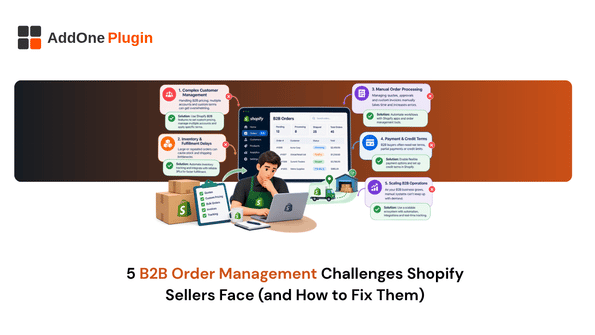
Every wholesale seller hits the same wall eventually: the process that worked fine at ten orders a month starts falling apart at a hundred. B2B order management challenges on Shopify tend to follow a predictable pattern, and most of them trace back to the same root cause, tools built for retail checkout being stretched to cover business terms they were never designed for. Here are the five that come up most often, and what actually fixes each one.
Why B2B Order Management Gets Harder as You Scale
Before getting into the individual challenges, it helps to understand why they all seem to show up around the same growth stage.
What breaks first, usually invoicing and payment terms
Retail checkout is instant: a customer pays, the transaction is done. B2B orders involve negotiated pricing and a payment window, and that gap between order and payment is where manual processes start to crack first.
Why generic Shopify setup isn’t built for wholesale volume
A default Shopify store assumes one price, one checkout flow, and immediate payment. Wholesale selling needs company-specific pricing, deferred payment, and a paper trail that a standard retail setup was never built to produce on its own.
Challenge 1, Manual, Inconsistent Invoicing
Creating each B2B invoice by hand works until it doesn’t. Once you’re generating a dozen or more a week, small inconsistencies (a wrong due date, a missing PO number) start creeping in, and those small errors are what actually slow down payment.
The fix: automated, branded invoice generation
Automating invoice creation as soon as an order is confirmed removes the manual step entirely, and it keeps every invoice formatted the same way whether you generated it at 9am or 9pm. InvoiceForge handles this by generating a compliant invoice the moment an order is ready to bill.
Challenge 2, Payment Terms and Cash Flow Gaps
Offering Net 30 or Net 60 terms is standard in B2B, but applying the wrong term to the wrong customer, or losing track of who’s overdue, creates real cash flow problems.
The fix: net terms by customer tier, tracked and enforced
Assigning payment terms at the company account level, rather than negotiating them order by order, keeps things consistent. We go deeper on how to structure this by customer tier in our guide to setting different payment terms for B2B customer tiers.
Challenge 3, No Visibility Into Order Source or Reorder Patterns
Many wholesale sellers can tell you what shipped last month, but not where the order actually came from, a trade show, a referral, an ad campaign, or which accounts are overdue for a reorder.
The fix: tracking and reorder tooling
Capturing order source data and reorder cadence turns guesswork into a real decision-making tool. We cover this specifically in our guide to tracking where B2B wholesale orders are coming from.
Challenge 4, Fragmented Purchase Orders and Receiving
On the buying side, receiving stock against a purchase order often means manually cross-referencing what arrived against what was ordered, then separately generating labels or updating records.
The fix: a clean PO-to-invoice paper trail
Keeping purchase orders, receiving records, and outgoing invoices connected to each other, rather than living in separate spreadsheets, removes most of the reconciliation headache. Our guide on Shopify purchase orders and inventory transfers covers the receiving side in detail.
Challenge 5, Customers Can’t Self-Serve Their Own Order History
If a B2B customer has to email you every time they want to check an order status or find an old invoice, that’s time your team is spending on questions the customer should be able to answer themselves.
The fix: giving B2B accounts real self-service tools
A customer account page that actually shows order history, invoice status, and an easy reorder option cuts down on that back-and-forth significantly. We’ve written specifically about how to give B2B customers order history and reorder tools on Shopify.
Most of these five challenges share the same underlying cause: a process built for one-off retail checkout, stretched to cover ongoing business relationships it wasn’t designed for. Fixing invoicing first tends to have the biggest immediate payoff, since it’s usually the piece eating the most manual hours each week. If that’s the one still slowing your team down, InvoiceForge is built specifically to take it off your plate.