
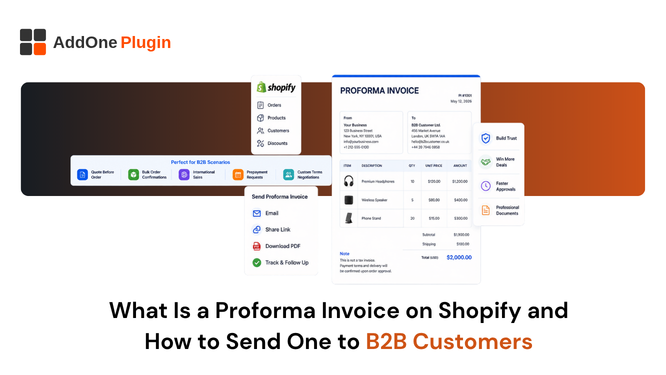
A proforma invoice is a preliminary bill of sale that states pricing and terms before a sale is finalized, without demanding payment at the time it is issued. If a wholesale buyer has asked you for one and you have never sent one before on Shopify, this guide covers exactly what it is, when it actually gets used, how it differs from every other document you might already be sending, and how to generate one from an order without guessing at the format or leaving out a field that gets it rejected by customs or bounced back by a buyer’s finance team.
Proforma Invoice vs. Standard Invoice
A standard invoice is a legally binding request for payment tied to a completed or confirmed order, and it carries real financial and legal weight the moment it is issued to a customer. A proforma invoice is genuinely not legally binding and does not demand payment at all. It exists purely to give a buyer clear, itemized cost expectations before they commit to anything, which is precisely why it shows up so often in B2B sales negotiations and in international shipping specifically, where costs need to be estimated before goods physically move across a border. Our guide on invoice versus receipt distinctions covers the closely related document types in genuinely more depth if you want the fuller picture of how all these terms relate to each other and where the boundaries actually sit between them.
The confusion between the two document types is understandable, since they can look nearly identical at a glance, same layout, same itemized line items, same company letterhead. The difference lives entirely in the label, the legal language, and the intent behind the document, not in how it is formatted visually. This is exactly why so many disputes trace back to a proforma invoice that was never clearly labeled as such, leaving a buyer’s accounts payable team to treat it as a real invoice and attempt to pay against it, or conversely, a buyer treating a genuine invoice as if it were still negotiable.
Why Proforma Invoices Aren’t Legally Binding
Because a proforma invoice represents an estimate rather than a finalized, confirmed transaction, prices, quantities, or shipping costs can still change before the actual final invoice is issued to the buyer. Buyers generally understand this going into the process, which is exactly why proformas are genuinely useful for negotiation and internal approval purposes without either party being financially locked into anything yet. This flexibility is the entire point of the document, not a limitation of it, and trying to treat a proforma as if it were binding, for example by chasing payment against one or refusing to adjust pricing after issuing it, undermines the reason buyers are willing to request one in the first place.
This also means a proforma invoice should never be used as a substitute for a real invoice simply because it is faster to generate. Some merchants are tempted to skip the final invoice step entirely once a proforma has been sent and paid informally, but doing so leaves you without a proper, compliant billing record for tax and accounting purposes, which becomes a real problem the first time your books are reviewed.
When B2B Buyers Ask for a Proforma Invoice
Two situations account for the large majority of proforma invoice requests in practice: customs clearance on international shipments, and internal budget approval processes before a purchase order is finalized on the buyer’s end. A third, less common but still meaningful situation is a buyer requesting one simply to have a formal record to circulate internally before their own board or purchasing committee signs off.
International Shipping and Customs
Customs agencies very often require a proforma invoice to assess duties and taxes before goods physically cross a border, since it gives them an itemized estimate of declared value and country of origin well ahead of the eventual final commercial invoice. Missing this document entirely, or providing an incomplete one, can genuinely delay a shipment sitting at the border for days while the paperwork gets sorted out, which is a cost nobody wants to absorb on a time-sensitive wholesale order, particularly one tied to a buyer’s own launch date or restocking deadline that they have already communicated to their own customers.
A shipment held at customs also creates a ripple effect beyond the immediate delay. The buyer’s own downstream customers or retail partners may be waiting on that inventory, which means a missing proforma invoice on your end can quietly damage a relationship several steps removed from your direct buyer, one you may never even hear about directly since the friction shows up entirely on their side of the relationship.
Formalizing a Quote Before Committing
A B2B buyer’s finance team frequently needs a genuinely formal document showing exact, itemized pricing before they can secure internal sign-off to place an order at all. A proforma invoice serves this purpose without creating any formal payment obligation on either side, which lets the buyer secure their own internal approval process before committing to anything concrete on your end as the seller. This is especially common with larger buyers where a purchase above a certain dollar threshold requires sign-off from someone beyond the person you have been negotiating with directly, sometimes a purchasing manager, sometimes a finance director several levels removed from your day-to-day contact.
How to Create a Proforma Invoice From a Draft Order
Shopify’s native draft order tool can be adapted to produce something close to a proforma invoice, though it genuinely lacks the explicit “proforma” labeling and specific terms language that a buyer’s finance team may reasonably expect to see on the document itself.
Step-by-Step Walkthrough
Create a draft order with the agreed products, quantities, and pricing exactly as discussed with the buyer, but do not send the invoice or request payment yet, since that would convert it into a genuine payment demand rather than an estimate the buyer can still adjust. Export or print the draft order details and manually add proforma invoice language and terms to the document, since Shopify does not label or format this document type natively out of the box, meaning a fair amount of manual work falls on you to make it look and read correctly every single time one is needed.
This manual approach works for an occasional proforma request, but it introduces real risk the more frequently you rely on it. A team member recreating the same manual edits repeatedly is eventually going to miss a field, use outdated terms language, or forget the validity date, none of which is obvious until a buyer or a customs official flags it.
Automating Proforma Invoices for Repeat B2B Buyers
For stores that regularly send proformas to wholesale buyers before finalizing orders as a standard part of their sales process, doing this manually for every single quote becomes a genuine bottleneck fast, particularly once you have several wholesale accounts active at once, each requesting quotes on their own schedule and each expecting a quick turnaround.
Converting a Proforma Into a Final Invoice
InvoiceForge treats proforma invoices as a fully native document type, generated directly from a draft order with the correct terminology and formatting already built in from the start. Once the buyer confirms the order, that same proforma converts directly into a final invoice without re-entering any data a second time, keeping your numbering sequence and all order details fully consistent throughout the entire process rather than starting fresh with a new document that has to be built from scratch every time terms are finalized. See our best invoice apps for B2B comparison for how this specific capability fits into a broader wholesale invoicing setup, and our guide on invoice number formats for how proforma and final invoice numbers should relate to each other without creating confusion for whoever is reviewing your records later.
Keeping the proforma and the final invoice linked in one system also matters for reporting. If a buyer asks how many proformas were issued last quarter versus how many actually converted into paid orders, that is a genuinely useful sales metric, and it is only easy to pull if both document types live in the same system rather than being scattered across manually edited draft orders that were never tracked centrally.
What to Include on Every Proforma Invoice
A proforma invoice missing key required fields can get rejected outright by customs authorities or bounced back entirely by a buyer’s finance team, undoing whatever time was supposedly saved by sending one in the first place rather than skipping straight to a final invoice once terms were agreed verbally.
Required Fields for Customs Clearance
Include a clear “Proforma Invoice” label, not just “Invoice”, since customs officials specifically look for this distinction and treat the two documents differently under their own regulations, sometimes rejecting a document outright if it is mislabeled or ambiguous. Add itemized product descriptions along with country of origin for each item, estimated shipping and handling costs, HS codes where applicable to the specific products being shipped, and a clearly stated validity date after which the quoted pricing may no longer apply, protecting you from being held to an old price if the buyer delays their final decision by weeks or months while internal approvals work their way through their own process.
Also worth including: your business registration details, a clear statement that the document is non-binding and for estimation purposes, and the currency the estimate is quoted in if you sell internationally, since a proforma without a stated currency can create genuine ambiguity for a buyer converting the estimate into their own budgeting process. Our wholesale invoicing setup guide covers exactly how proforma invoices fit alongside PO numbers and net terms as part of a genuinely complete B2B document workflow, rather than as an isolated one-off document type disconnected from the rest of your invoicing system.
It is worth building a checklist of these required fields into your actual template so nothing gets forgotten under time pressure when a buyer needs a proforma quickly ahead of an approaching customs deadline or an internal budget cutoff date on their end. A missing HS code or an unclear validity date is a small omission that can cost real time to fix once a shipment is already in transit and the paperwork needs to be corrected retroactively, sometimes requiring a corrected document to be couriered separately to a customs office rather than simply emailed.
Proforma invoices are a small but genuinely important piece of the B2B and international sales process, and getting the document right the first time avoids delays that are entirely preventable with a small amount of upfront template work. InvoiceForge generates them as a standard, built-in document type and lets you convert one into a final invoice with a single click once the order is confirmed by the buyer.