
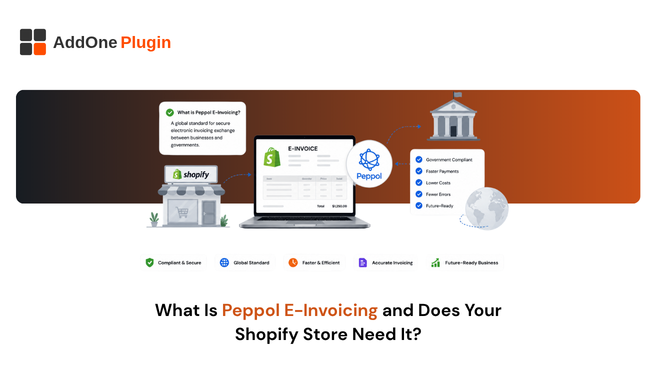
If you sell B2B into Belgium, or you are watching similar mandates roll out across the EU, “just send a nice PDF invoice” no longer satisfies the law. Peppol e-invoicing is now a legal requirement for a growing list of countries, and most Shopify merchants have not caught up to what that actually means for how they issue documents. Here is what Peppol is, who is affected right now, and why a PDF alone may not be enough.
What Peppol E-Invoicing Actually Is
Peppol e-invoicing is a structured, machine-readable invoice format transmitted through a standardized network, rather than a PDF or paper document that a person reads visually.
Structured data vs a PDF that looks like an invoice
A traditional PDF invoice is designed to be read by a person. A Peppol e-invoice is structured data, formatted to the European standard EN 16931, designed to be read directly by another business’s accounting or ERP system without any manual re-entry. A PDF can still be provided alongside it for human reference, but under a Peppol mandate, the structured file is the legally valid document, not the PDF a person actually opens and looks at.
The Peppol network and Access Points
Peppol e-invoices travel through a network of certified Access Points, service providers that transmit the structured invoice directly between businesses’ systems. You cannot send a Peppol e-invoice without going through one, and choosing or connecting to an Access Point is a genuine technical integration step, not a checkbox setting.
Which Shopify Merchants Are Affected Right Now
Belgium’s mandatory B2B e-invoicing rules
As of January 1, 2026, companies established in Belgium are required to issue structured e-invoices for most domestic B2B sales to other Belgian VAT-registered businesses. A PDF or paper copy can still be provided for convenience, but it is only a visual representation; the structured e-invoice is the legally valid document, and the distinction is not optional.
Countries rolling out similar mandates
Belgium is not an isolated case. Localized systems like ZUGFeRD in Germany and Factur-X in France are part of the broader EU push toward continuous e-reporting under the VAT in the Digital Age initiative, with more country-level mandates expected to follow over the coming years as that initiative continues to roll out across member states.
B2C and exempt sales
These mandates target B2B and B2G transactions specifically. B2C sales to consumers, and certain VAT-exempt businesses, generally fall outside the scope, at least for now, though the direction of regulatory travel across the EU suggests this scope is more likely to expand than shrink over time.
Is a PDF Invoice Enough If Peppol Applies to You?
No. Where a Peppol mandate applies, a PDF invoice on its own does not satisfy the legal requirement, regardless of how complete or professional it looks, because the legally valid document is the structured e-invoice, not its visual representation.
Why PDF-only invoices fail compliance
A PDF can contain every required field and still fail compliance because compliance under Peppol is about the format and transmission method, not just the content displayed on the page. A beautifully designed, fully itemized PDF invoice that never goes through a certified Access Point simply does not satisfy a Peppol mandate, no matter how correct its content is.
What “legally valid” means under Peppol
For a qualifying sale, the structured e-invoice needs to be generated in the correct format, typically Peppol BIS Billing 3.0, and transmitted through a certified Access Point to the customer’s Peppol endpoint. Emailing a well-formatted PDF, even one with every legally required field present, does not meet that bar once a mandate applies to the transaction.
What to Confirm Before You Assume You’re Covered
This is not a feature to take on trust from a general “VAT compliant” claim on a pricing page. Structured e-invoicing through a certified Access Point is a specific technical capability, separate from generating a well-formatted, compliant PDF invoice, and not every invoicing app that handles VAT fields correctly also handles Peppol transmission.
Ask your invoicing provider directly
If Peppol applies to any part of your business, ask specifically whether your invoicing app generates the structured e-invoice format and transmits it through a certified Access Point, not just whether it produces a compliant-looking PDF. The two are easy to conflate and only one of them satisfies a live mandate.
Treat this as separate from your general VAT compliance setup
Getting VAT/GST fields right on a PDF invoice is necessary groundwork either way, but it is a different requirement from Peppol transmission specifically. Confirm both independently rather than assuming one implies the other.
Getting Ahead of E-Invoicing Mandates
Readiness checklist
- Confirm whether any country you sell B2B into currently requires structured e-invoicing.
- If it does, verify your invoicing setup actually transmits through a certified Access Point, not just generates a well-formatted PDF.
- Keep an eye on additional country rollouts, since this is an active, expanding regulatory area rather than a settled one.
- Talk to your tax advisor before assuming any existing tool covers a mandate that is new to your business.
- Cross-check your current invoice fields against what a VAT invoice legally requires, since e-invoicing compliance builds on top of, rather than replaces, standard VAT invoice requirements.
Where to watch for new mandates
Germany’s ZUGFeRD e-invoicing requirements and Germany’s broader Shopify invoice compliance rules cover the closest related mandate already live in a major EU market, and are a useful reference for how these requirements tend to be phased in over time.
E-invoicing mandates are moving from “something to watch” to “something you are already required to do” faster than most merchants expect. Belgium is live now, and the broader EU direction points toward more countries following a similar path. Assuming your current setup covers it, without actually checking, is the riskiest option on the table.