
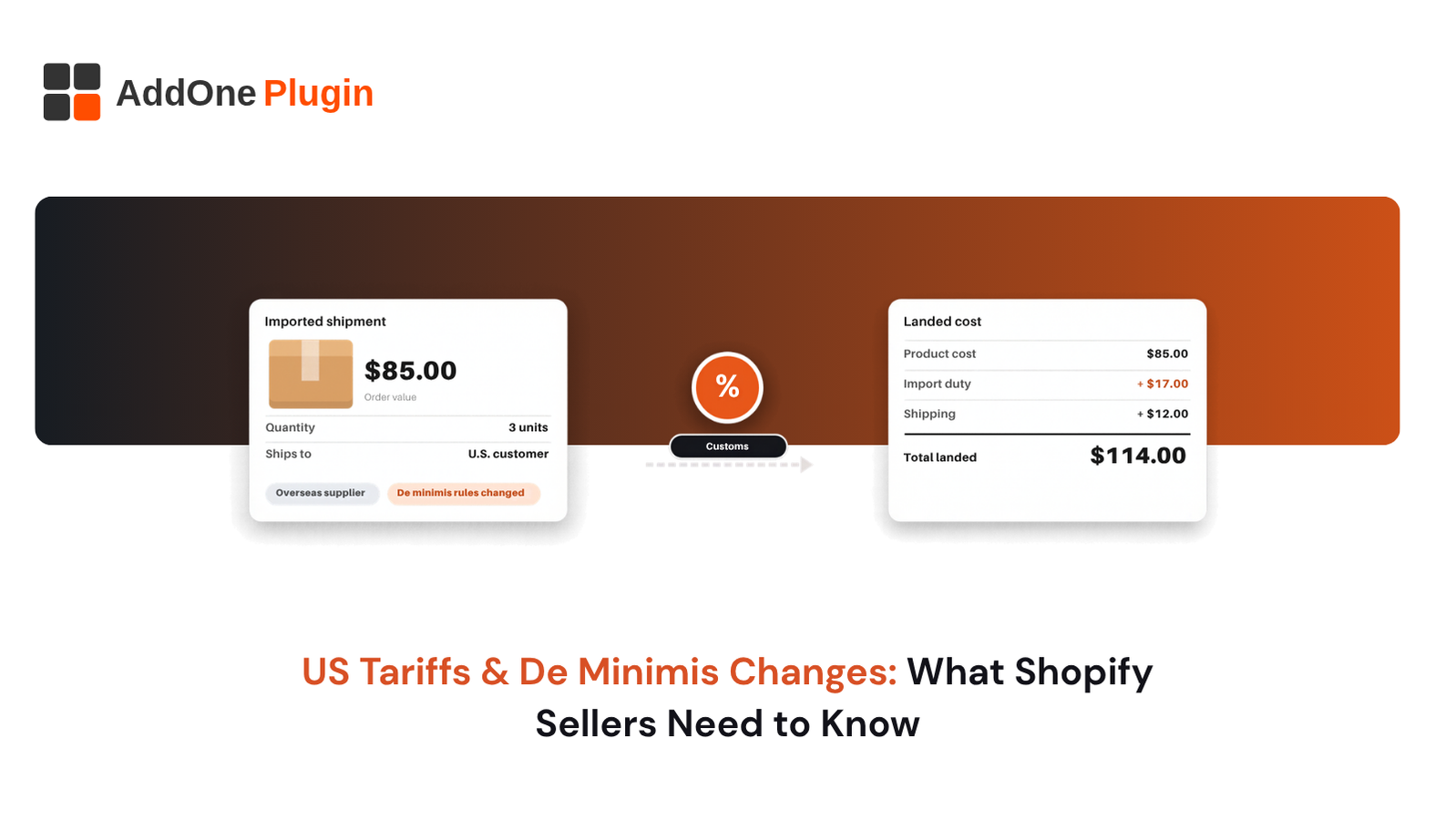
Orders that once crossed the US border duty-free now arrive with a bill attached. On June 24, 2026, U.S. Customs and Border Protection (CBP) published rules indefinitely suspending the $800 de minimis exemption for low-value shipments, and Congress ends the exemption by statute on July 1, 2027. For anyone searching US tariffs and de minimis on Shopify, the practical question is simple: who pays, how much, and what should your checkout say?
This guide covers what changed, what stays uncertain, and how to calculate landed cost with a worked example. You also get store settings to review and a checklist to work through. Rules in this area move fast, so everything below is stated as of October 2026, and we point you to the official sources instead of guessing where things are still unsettled.
US Tariffs and De Minimis: What Changed and Where Things Stand Now
Tariff news arrives from the courts, the White House and federal agencies, often in the same month. The sections below separate what the official record confirms from what you should keep checking.
The End of the $800 De Minimis Exemption
For years, the de minimis rule let shipments worth $800 or less enter the US without duties or formal entry. That rule is suspended, and the suspension is now written into CBP regulations.
Executive Order 14324, published in the Federal Register on August 5, 2025, suspended duty-free de minimis treatment for all countries. CBP’s own rulemaking describes the exemption as suspended since at least August 29, 2025. On June 24, 2026, CBP published two interim final rules: one for all modes other than the international postal network, effective June 24, 2026, and one for mail shipments, effective July 24, 2026.
The practical effect is that goods valued at $800 or less must now use formal or informal entry procedures. Informal entry is the simplified route for shipments valued at $2,500 or less, and formal entry generally applies above that.
The 2026 Tariff Timeline
Here are the dated events that matter for sellers, each taken from an official source:
- February 20, 2026: The Supreme Court decided Learning Resources, Inc. v. Trump and held that the International Emergency Economic Powers Act (IEEPA) does not authorize the President to impose tariffs.
- February 24, 2026: A temporary import surcharge of 10% under Section 122 of the Trade Act took effect for a period of 150 days, under a proclamation published in the Federal Register on February 25, 2026.
- June 24, 2026: CBP published the interim final rules suspending de minimis indefinitely.
- July 24, 2026: The postal de minimis rule took effect, and new Section 301 tariffs took effect on products of 60 economies. The Section 122 surcharge reached the end of its 150-day period in July 2026.
The Section 301 action is the one most sellers need to read. In a notice published July 28, 2026, the U.S. Trade Representative set additional duties of 10% or 12.5% on products of the investigated economies, with certain exemptions listed in the notice’s annexes. Which rate applies to a given country, and whether it applies on top of or net of the normal duty, is spelled out in the notice, so read the entry for your supplier’s country.
Tariff measures can be, and have been, challenged in court. We do not summarize litigation status here because it changes too quickly, so check the sources listed in the monitoring section below.
What Is Scheduled for 2027
The One Big Beautiful Bill Act (Public Law 119-21, Section 70531) terminates the statutory de minimis exemption effective July 1, 2027. CBP’s June 2026 rules cite that date. Today’s suspension rests on executive and agency action. Next year’s repeal rests on law.
That difference matters for planning. Even if a court narrows an executive action, the 2027 repeal stays on the calendar. Build your pricing and checkout around a world where low-value US orders always carry duties, and treat any rollback as a bonus rather than a plan.
What Is the De Minimis Exemption, and Is It Still in Effect?
The de minimis exemption let shipments valued at $800 or less enter the US without duties or formal entry. It is suspended indefinitely for both non-postal and postal shipments under CBP’s June 24, 2026 rules, and Congress repeals it by statute on July 1, 2027.
Your shipping method decides how the new rules reach your orders, so the sections below break it down.
The Short Answer
No, you cannot rely on de minimis for US-bound orders. Goods that used to enter duty-free now need an entry and are subject to the duties that apply to them.
The exemption’s old logic also reached pricing. Many sellers priced $50 orders knowing no duty applied. That assumption no longer holds. Every US order now needs a duty calculation, even when the resulting amount is small, and your checkout needs a plan for it.
How It Applies to Non-Postal vs. Postal Shipments
Non-postal shipments, such as express couriers and freight, have faced the new rule since June 24, 2026. They go through formal or informal entry, and the importer of record is responsible for the duty.
Postal shipments follow a separate track. CBP’s mail rule creates a postal informal entry process for mail valued at $2,500 or less, effective July 24, 2026. In the process described in the rule, qualified third parties submit monthly data on the prior month’s shipments and pay duties through Pay.gov.
The rule also sets a compliance date of October 22, 2026 for certain requirements. Until then, CBP allows some postal merchandise to use the postal informal entry process: items subject to partner government agency requirements, items subject to Chapter 98 or 99 duties, and items claiming duty-free treatment under Chapter 98 or a free trade agreement. Ask your carrier or postal partner how they now handle US-bound parcels, because they may handle entry and billing differently.
Legal Uncertainty to Watch
Expect more change. CBP issued both June 2026 rules as interim final rules, and the comment period closed on July 24, 2026, so the agency can revise the rules in response. Tariff measures can be challenged in court, as the Supreme Court’s IEEPA decision shows, so the picture for Section 301 and other measures can shift.
Two conclusions follow. First, current rates and rules are accurate as of October 2026, not permanent. Second, the 2027 statutory repeal limits how far any rollback of de minimis can go.
Check official sources monthly, and keep your pricing flexible enough to adjust within days.
Who Pays US Tariffs on Shopify Orders?
The importer of record pays US duties to CBP. On most Shopify orders, that is you if you ship delivered duty paid, or your customer if you ship delivered duty unpaid. Your checkout setup and shipping terms decide which, so choose deliberately before orders arrive.
Three pieces drive the answer: who the importer is, which shipping term you use, and what your carrier charges to handle the paperwork.
Importer of Record: You or Your Customer
The importer of record is the party legally responsible for declaring goods and paying duties. For a cross-border Shopify sale, it is either the seller, a service acting for the seller, or the buyer who receives the parcel.
If you ship from outside the US, you usually are not set up as an importer, so a carrier or broker acts on someone’s behalf. If you ship from a US warehouse using goods you already imported, duties were paid at import. Confirm which situation applies to each product line before you choose a checkout approach.
DDP vs. DDU: Pros, Cons and Customer Experience
Delivered duty paid (DDP) means the customer pays duties and taxes at checkout and nothing at the door. Delivered duty unpaid (DDU) means the carrier collects them on delivery.
DDP gives a smoother experience and fewer refused parcels, but your checkout must show a higher total and your duty data must be accurate. DDU keeps checkout totals low, but surprise bills lead to refusals, returns and bad reviews.
Shopify has moved toward DDP. According to the Shopify Changelog, Managed Markets stopped supporting DDU on August 24, 2026 in every country and region where it supports DDP. Markets that used or inherited DDU moved to DDP automatically, so customers there pay duties and taxes at checkout.
Carrier Brokerage and Duty-Handling Fees
Carriers often charge a fee to clear goods and advance duties, separate from the duty itself. These fees vary by carrier, service and shipment value, and carriers revise them regularly.
Under DDP, you pay these fees or fold them into your shipping price. Under DDU, the customer pays them at the door, which is a common source of complaints. We do not quote figures here because each carrier publishes its own schedule.
Request a written fee schedule from your carrier, and add it to your landed-cost sheet.
How Do You Calculate Landed Cost After the De Minimis Change?
Landed cost is the full price of getting a product to your customer: product cost, shipping, insurance, duties, taxes and fees. Since de minimis was suspended, calculate duty for every US-bound order from the product’s HS code, country of origin and value, then add brokerage and any taxes.
A repeatable formula keeps you from guessing on each order.
Duty Rate, HS Code and Country of Origin
Three data points set your duty. The HS code classifies the product and sets the base rate. The country of origin decides whether additional tariffs apply. The customs value, usually the price paid for the goods, is the amount the rate applies to.
More than one measure can apply to the same product, such as a base duty plus an additional tariff tied to its origin. Look up each code in the official US Harmonized Tariff Schedule instead of copying a number from a blog, and confirm any special measures with your customs broker.
Store the code and origin on every product in your Shopify admin. Shopify’s changelog describes its duty calculation as based on the HS code and country of origin applied to your products, so clean data is the foundation of every number that follows.
Worked Example: Absorb vs. Pass Through
This example is illustrative. The 25% duty rate and the $5 brokerage fee are placeholders, not real rates. Replace them with your own.
| Line | Absorb the duty | Pass it through |
|---|---|---|
| Item price | $60.00 | $60.00 |
| Product cost | $20.00 | $20.00 |
| Shipping cost (free to customer) | $8.00 | $8.00 |
| Duty at 25% of $60 (placeholder) | $15.00 paid by you | $15.00 paid by customer |
| Brokerage (placeholder) | $5.00 paid by you | $5.00 paid by customer |
| Your margin | $12.00 | $32.00 |
| Customer pays | $60.00 | $80.00 |
Absorbing cuts the margin from $32 to $12. Passing it through keeps your margin but raises the checkout total from $60 to $80.
Pricing and Margin Adjustments
You have three levers: absorb, pass through, or build duty into the product price. Building it in keeps checkout clean but compounds, because duty applies to the higher price. In the example above, holding a $32 margin while paying the duty yourself requires a price near $86.67, since 75% of the price must cover cost, shipping, brokerage and margin.
Pick one approach per market and test it. Review rates every month, because tariff changes flow straight into your margin. Keep a small buffer in your pricing so a rate change does not force an emergency overhaul. Remember to count payment processing costs in the same margin sheet; our guide to payment gateway choice and cash flow on Shopify B2B orders shows how fees add up.
Setting Up Your Shopify Store for Tariffs and Duties
Policy changes only help you when the store reflects them. Our team at Inshalytics customizes Shopify checkouts, product data and policy pages for cross-border sellers, and the steps below work whether you build them yourself or bring in help.
Think of the setup as four layers: settings, messaging, documents and performance. If one layer fails, customers see it as a surprise charge or a confusing page.
Shopify Duties and Import Taxes Settings
Customs authorities set duties from the product’s classification, its origin and the destination’s rules, and Shopify’s duty tools need that product data to calculate them. Shopify’s changelog also notes a setting for postal tariff rate calculations on orders shipping into the United States, which suits stores that ship with a postal carrier.
Start by adding an HS code and country of origin to every product. Then review your Markets settings and your duty-collection method. If you used Managed Markets with DDU, check your markets, since they moved to DDP on August 24, 2026. If you want customers to keep paying on delivery, Shopify’s changelog says to turn off Managed Markets before that date, so review how your setup now behaves rather than assuming.
How duty collection works for US-bound orders depends on your plan, shipping origin and markets. Check Shopify’s Help Center for your configuration before you change anything.
Checkout Messaging and Product-Page Shipping Notes
Customers accept costs they understand. Put one clear line on every product page and in the cart, such as “Duties and import taxes are calculated at checkout” or “Duties and taxes are not included; your carrier collects them on delivery.”
Match the message to your real setup. A promise of “no extra fees” with DDU invites chargebacks. Link the line to your shipping policy so customers can read the details.
Review your shipping and returns pages at the same time. State who pays duties on returns, what happens to refused parcels, and how long customs delays can last, so support does not have to improvise.
Commercial Invoices and Customs Data Accuracy
Every parcel needs accurate customs data: product description, HS code, country of origin, quantity and value. Vague descriptions such as “gift” or “samples” slow clearance, and wrong values invite penalties.
Declare the true transaction value. Undervaluing goods to dodge duties creates legal risk, and it fails when customs checks the order. Sync your product data with your shipping tool so invoices pull the same fields your checkout uses, and audit a sample of invoices each month. If you manage wholesale paperwork as well, our comparison of Shopify and WooCommerce B2B invoicing covers the invoice side.
Checkout Performance and Cart Abandonment
Unexpected costs are a classic reason shoppers leave a cart. We have no verified figure to quote, so measure it yourself: compare abandonment before and after you add duties to your checkout.
Show duties early. Display estimated landed cost on the cart page, not just on the last step. Keep the checkout fast, and remove steps that add friction. Track abandonment by country, so you see exactly where the new duty line hurts.
Need help? Our team offers a Shopify checkout and shipping-policy audit that reviews your duty settings, messaging and conversion path.
Next Steps: A Tariff-Readiness Checklist for Shopify Sellers
You do not need to solve everything at once. Start with data and messaging, then build a habit of checking for updates.
What to Do This Week
Work through this list in order:
- Export your US-bound products and flag any missing HS codes or origin countries.
- Confirm with your carriers how they treat US-bound parcels and what fees they charge.
- Choose DDP or DDU for each market and match your checkout settings.
- Update product-page and cart messaging.
- Rebuild your landed-cost sheet using real rates.
- Review prices on your top 20 products.
- Update your shipping and returns policy pages.
Finish steps one through three first, because the rest depend on them.
How to Monitor Rule Changes
Set a monthly review and use official sources. Check the Federal Register and CBP’s customs updates for rule changes, the U.S. Trade Representative for Section 301 actions, and the Shopify Changelog for platform updates. Ask your carrier to flag changes to US entry procedures.
Mark July 1, 2027 on your calendar, the date de minimis ends by law. If you also ship to Europe, read our guide to EU customs fees for Shopify stores, because the EU ended its own duty-free threshold on July 1, 2026.
Conclusion
The $800 shortcut is closed, and it is not coming back in a form you can plan around. Sellers who win from here know their HS codes, state their shipping terms plainly, and price with landed cost in mind. Everyone else absorbs surprise costs or loses customers at checkout.
Start with your product data, pick DDP or DDU on purpose, and review the rules monthly. Rules will keep changing, so build a store that adapts quickly.
Want a second opinion? Book a Shopify checkout and shipping-policy audit with the team at Inshalytics, and we will find the gaps before your customers do.
This article is general information, not tax or legal advice. Confirm current rates and requirements with CBP, your customs broker or a qualified adviser.