
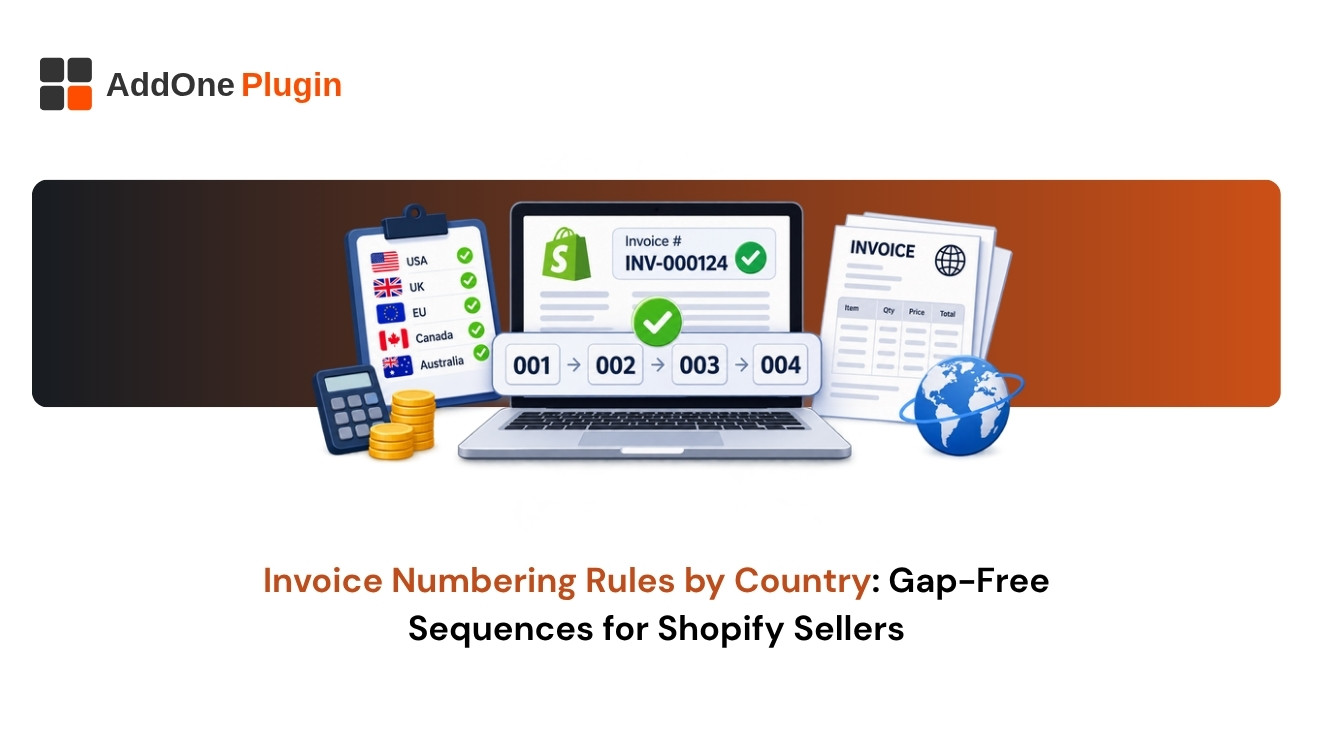
An auditor asks why invoice 1042 is missing from your records. If you cannot answer, you have a numbering problem. Invoice numbering rules look simple, but online stores create gaps constantly: cancelled orders, drafts, refunds and test purchases all disturb the sequence.
This guide explains the invoice numbering rules that apply to most sellers, how they differ by country, and how to keep a clean series when your sales run through Shopify.
What Are the Invoice Numbering Rules?
Invoice numbering rules require each invoice to carry a unique identifier, and many tax authorities expect those identifiers to follow a clear sequence. The aim is traceability: every invoice can be found, and none can quietly disappear. The details vary by country, so treat this section as the common ground and the next one as the local detail.
Unique and sequential: what that means
Unique means no two invoices share a number. Sequential means numbers increase in a predictable order without unexplained gaps. Some jurisdictions accept several separate series, as long as each series is itself consistent.
Letters, prefixes and year formats
Formats such as INV-2026-0001 are normal. Prefixes can separate document types or business units, and a year in the number can make resets easy. Keep the format stable once you start, because changing it mid-year invites questions.
Where the invoice number must appear
Put the number prominently on the document, usually at the top beside the date. Credit notes need their own numbers and should reference the invoice they correct.
Do Invoices Have to Be Sequentially Numbered?
In many countries, yes: tax rules require a unique number, and often a sequence, so each document can be identified. Check your own authority’s guidance before you design a system.
UK
HMRC’s VAT guidance requires a unique, sequential invoice number, and you should be able to explain any missing numbers. See HMRC’s VAT Notice 700 for the official wording, and our UK VAT invoice requirements guide for the full list of fields.
EU
The EU VAT Directive asks for a sequential number, based on one or more series, that uniquely identifies the invoice. Member states add their own detail. For Germany, see our Germany Shopify invoice compliance guide.
Australia and other markets
Australia’s GST rules for tax invoices focus on required content, and a unique number is standard practice. Our Australia GST invoicing guide covers the details. Many other markets, including the US, have no statutory sequencing rule, but accounting discipline still calls for one. If you sell across several countries, follow the strictest rule that applies to you.
Invoice Numbering Rules for Online Stores
Online stores face problems that a plumber with a paper pad never meets. Orders get cancelled, edited and refunded in minutes.
Why the Shopify order number is not enough
The order number is created when the order is placed, not when an invoice is issued. Cancelled orders and draft orders leave holes, and the order number cannot restart or run separate series. Use an independent invoice counter instead. Our guide shows how to customize the Shopify invoice number format.
Cancelled orders and gaps
If an invoice was issued, do not delete it when the order is cancelled. Issue a credit note that cancels it, so the number stays in the record. If no invoice was ever issued, no number was used and there is no gap.
Credit notes and refunds
Give credit notes their own series or a clear prefix, and reference the original invoice. Here is how to send a credit note after a refund.
Separate series for B2B and retail
Many sellers keep one series for wholesale invoices and another for retail receipts. That is acceptable where rules allow multiple series, and it makes reporting easier.
How Do You Set Up a Numbering System?
Choose a format, set a starting number, decide on resets, and lock numbers once issued. Write the rule down so everyone on the team follows it.
Choosing a format
A good format is short, readable and future-proof. Include a prefix for the document type and enough digits to avoid overflow, for example six digits.
Starting number and resets
Start at 1 or continue from your old system. If you reset each year, put the year in the number so two invoices never share an identifier.
Automate Compliant Numbering With InvoiceForge
Manual numbering breaks the first time two orders arrive at once. InvoiceForge assigns numbers automatically as documents are generated.
Independent invoice series
InvoiceForge numbers documents separately from Shopify order numbers, so cancelled orders do not create gaps in your invoice series.
Locked invoices after generation
Once a document is generated, it is not rewritten. Changes flow through credit notes, which keeps your record intact. Try it on the free plan.
Next Steps
Review your current series, find the gaps, and decide which of them you can explain.
Numbering audit checklist
- Is every number unique?
- Can you explain each gap?
- Do credit notes reference the original invoice?
- Is the format documented and stable?
Related guides
Read professional invoices on Shopify and the VAT invoice guide for the UK, EU and Australia.
[…] from a consistent series and a date. Keep the series clean, because gaps invite questions. Read our invoice numbering rules guide for the […]